
Daniil Trifonov Turned to the Americas for Mi Historia Americana
6 min read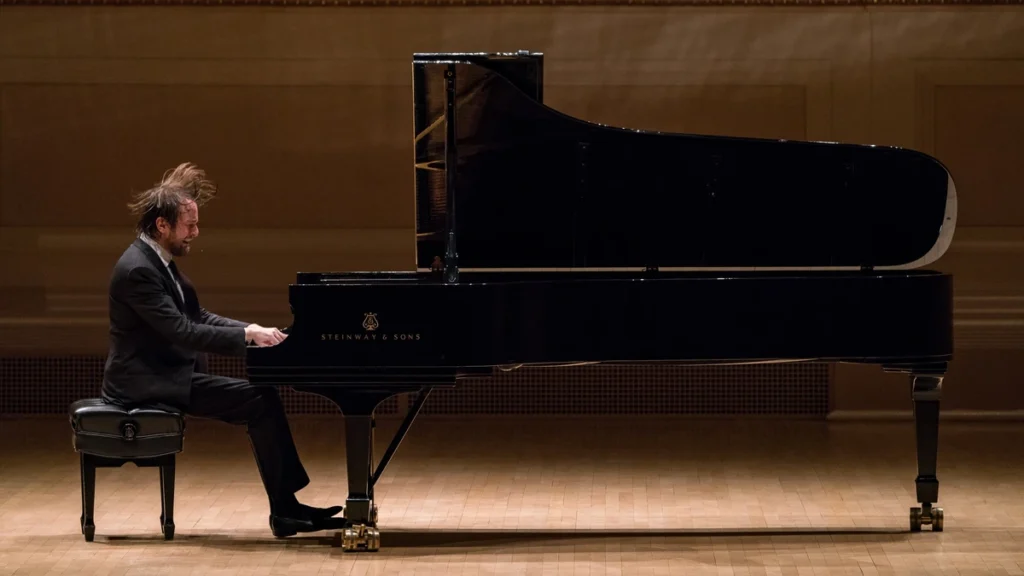
Daniil Trifonov performing at Carnegie Hall.
Daniil Trifonov performing at Carnegie Hall.
Daniil Trifonov releases Mi Historia Americana: Sur on 2 October through Deutsche Grammophon, the second half of a project covering the music of the Americas.
The first volume went north. This one runs from Cuba and the Dominican Republic through Brazil and Peru to Argentina.
A Two-Part Project With a Direction
Splitting the Americas into a northern and a southern volume is a structural decision that shapes what each record can contain.
The north volume had a body of repertoire with an established recording history and a reasonably settled canon behind it.
The south volume has to do more work. The Latin American piano repertoire is enormous, unevenly documented, and largely absent from the standard international recital programme.
That makes the second record the more interesting of the two, because far more of it will be unfamiliar to the audience it is aimed at.
Recorded With a Brazilian Orchestra
The orchestral works were recorded with the Sao Paulo Symphony Orchestra, which is a meaningful choice rather than a convenience.
OSESP has become one of the most significant orchestras in the southern hemisphere and has built a substantial recording catalogue of Brazilian and Latin American repertoire.
Recording this material with a European or North American orchestra would have been simpler logistically and would have produced a different record.
Two Orchestral Works, Both Arranged
The orchestral portion consists of Barroso’s Aquarela do Brasil and Golijov’s Cuadros del Sur, both arranged specifically for the project.
Aquarela do Brasil is one of the most recognisable pieces of Brazilian popular music, written in 1939 and known internationally under a shortened title.
Arranging it for piano and orchestra places a popular song inside a concert frame, which is a move with a long and sometimes uncomfortable history.
Cuadros del Sur Was Co-Commissioned
Osvaldo Golijov’s Cuadros del Sur is a co-commission by OSESP, Deutsche Grammophon, the Orchestre Philharmonique de Radio France and the Aspen Music Festival.
Four-way commissioning is now standard for new orchestral work, because no single institution can absorb the cost alone.
It also guarantees the piece multiple performances, which is the difference between a new work entering the repertoire and disappearing after its premiere.
The Solo Repertoire Is the Substance
The solo half draws on Gabriela Lena Frank, Ginastera, Guarnieri, Lecuona and Villa-Lobos, among others.
Villa-Lobos and Ginastera are the two Latin American composers with any real foothold in international concert programming, and even they are played selectively.
Lecuona is known mainly through a handful of pieces, Guarnieri is barely played outside Brazil, and Gabriela Lena Frank is a contemporary composer working in the Peruvian and American traditions at once.
Trifonov Wrote One of the Tracks
The album includes a piece of his own, a Tango, which is a small but telling inclusion.
Composing is not a normal part of a concert pianist’s job in the way it was in the nineteenth century, when performers routinely played their own material.
Including an original piece on a survey album positions the pianist inside the tradition rather than only in front of it.
Three LPs and a Separate Encore Disc
The release appears digitally, on two CDs and on three LPs, with an additional five-track vinyl called The Encores issued the same day.
That is an unusually elaborate physical rollout for a classical release in 2026.
It reflects where the money now is. Classical listeners buy physical media at rates the rest of the industry lost twenty years ago, and vinyl in particular has returned as a serious format.
What a Survey Album Risks
Records organised around a region or a theme have a structural weakness: they can become tourism rather than programming.
A piece included because it represents a country rather than because it is worth hearing weakens the whole sequence.
The defence is depth of selection, and the presence of Guarnieri alongside the obvious Villa-Lobos and Ginastera suggests the choices were made from inside the repertoire rather than from a list.
The Canon Problem This Addresses
The international classical repertoire is overwhelmingly European and largely fixed, and Latin American composers are represented in it by a handful of pieces.
That is a distribution problem rather than a quality one. The music exists, it has been recorded locally, and it has not travelled.
A major-label release from a pianist with an international audience is one of the few mechanisms that moves repertoire across that boundary.
Trifonov’s Career So Far
Trifonov emerged through the competition circuit and has spent the years since building a catalogue that alternates between core repertoire and larger conceptual projects.
He has recorded complete cycles, transcription albums and thematic surveys, which is a more varied approach than most pianists at his level take.
A two-volume geographical project is consistent with that habit. He appears to prefer records with an organising idea to records that are simply recitals.
Piano and Orchestra on a Survey Record
Combining orchestral and solo material on one album is unusual and creates a practical problem: the two are recorded in different conditions and sound different.
A solo piano recording is intimate and close. An orchestral recording is wide and reverberant, and the piano sits inside a much larger acoustic.
Sequencing across that gap requires either careful mastering or a deliberate acceptance of the contrast, and either choice shapes how the record is experienced.
Why October
Early October places the record in the autumn classical release window, at the start of the concert season and well inside award-eligibility periods.
Classical releases cluster there for the same reason the rest of the industry does: reviewers are active, retail is stocked and the audience is back from the summer.
For a two-disc set with a three-LP edition, that timing also puts it in front of the physical-buying market ahead of the end-of-year period.
Why This Repertoire Never Travelled
The absence of Latin American piano music from international programmes has causes that are structural rather than musical, and they are worth setting out.
Scores are the first obstacle. Much of this repertoire was published locally in small runs by houses that no longer exist, and a pianist in Europe who wants to programme Guarnieri has to find the music before they can learn it.
Competition repertoire is the second. Young pianists build programmes around what competitions accept, competitions accept what juries know, and juries know the European canon. The feedback loop is closed and self-reinforcing.
Presenters are the third. A recital promoter selling tickets on name recognition will not risk a programme of composers the audience has not heard of, which keeps the unfamiliar material out of the halls where it might become familiar.
Popular Song Inside a Concert Frame
Arranging Aquarela do Brasil for piano and orchestra puts a specific question on the table, and classical music has answered it badly often enough to make people wary.
The bad version treats popular material as raw ore to be refined: the tune is kept, the rhythmic character is smoothed out, and what emerges is a concert piece that has removed everything that made the song work.
The good version treats the arrangement as a translation rather than an elevation, keeping the rhythmic identity intact and letting the orchestra serve it. Whether an arrangement lands on one side or the other is usually obvious within thirty seconds.
Recording it with a Brazilian orchestra materially improves the odds, because the players have the idiom in their hands rather than reading it off a page.
What Is Actually Being Tested
Two things. Whether a survey of a continent can hold together as an album rather than reading as an anthology with a pianist attached.
And whether repertoire this under-recorded gains anything from being played by an outsider to the tradition, or whether the value is mainly in the distribution.
Two orchestral arrangements, a continent’s worth of solo repertoire, a Brazilian orchestra, and a Tango by the pianist himself.
About The Author