Yo-Yo Ma Recorded Both Shostakovich Cello Concertos With Nelsons
6 min read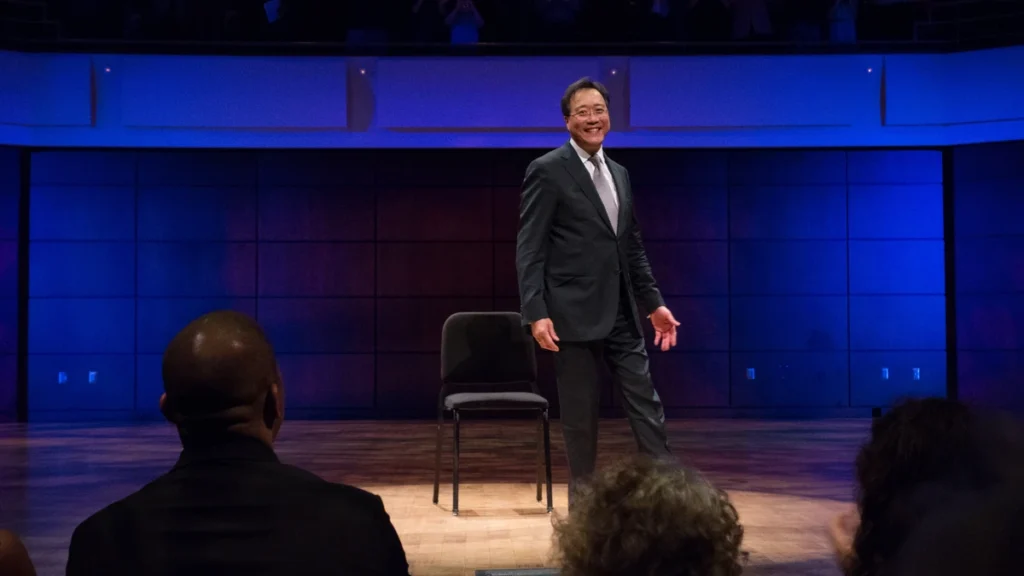
Yo-Yo Ma taking a bow in Birmingham, Alabama.
Yo-Yo Ma taking a bow in Birmingham, Alabama.
Yo-Yo Ma recorded both Shostakovich cello concertos with Andris Nelsons and the Boston Symphony Orchestra at Symphony Hall in October 2023, and the release won Best Classical Instrumental Solo at the 68th Grammy Awards on 1 February 2026.
It is his twentieth Grammy.
Recording both is the decision worth noting. The first concerto is standard repertoire; the second is not.
Two Concertos, Two Reputations
The first cello concerto, written in 1959, is one of the most played concertos in the instrument’s repertoire and a fixture of competition and audition lists.
The second, from 1966, is played far less often. It is longer, slower to arrive anywhere, and considerably harder to make sense of on a first hearing.
Programming them together is therefore not symmetrical. One piece brings an audience and the other asks something of it.
That imbalance is exactly why the pairing is interesting. A recording of the first alone competes against dozens; a recording of both is a statement about the composer rather than about the repertoire.
Both Were Written for the Same Cellist
Shostakovich wrote both concertos for Mstislav Rostropovich, who premiered them and whose recordings remain the reference points.
Writing for a specific player shapes a piece at the level of what is physically comfortable and what is deliberately not, and Rostropovich’s technique is embedded in the writing.
Every cellist who takes the pieces on is therefore in conversation with a particular performer as well as with a composer.
The Nelsons Shostakovich Project
Andris Nelsons and the Boston Symphony have been working through the Shostakovich catalogue for years, and this recording sits inside that larger effort.
Long-form recording projects of that kind have become rare, because they require sustained institutional commitment and a label willing to fund them.
What they produce is depth. An orchestra that has recorded most of a composer’s symphonies approaches a concerto with an established sense of the idiom.
A Category Containing Two Boston Shostakovich Records
The same Grammy category also contained a recording of the Shostakovich piano concertos, likewise with Nelsons and the Boston Symphony.
Two nominations from the same partnership and the same composer in one category is unusual and reflects the scale of the project rather than any coincidence.
It also created an oddly direct comparison, since the differences between the two records came down to the soloist and the instrument rather than to interpretation of a shared style. The cello record took the award.
What the Second Concerto Asks For
The second concerto is a late work and it behaves like one. It is discursive, harmonically ambiguous and reluctant to resolve.
Where the first has a driving motor and a famous horn call, the second builds from fragments and takes its time.
Playing it convincingly requires the soloist to sustain interest across long stretches with very little conventional momentum, which is a different skill from the one the first concerto tests.
Ma’s Position in Classical Music
Yo-Yo Ma has been the most publicly recognisable classical instrumentalist in the world for decades, which is a strange position to occupy inside a small field.
He has won numerous Grammys, recorded across an unusually wide range of repertoire and traditions, and maintained a career built as much on collaboration as on the standard concerto circuit.
That breadth has occasionally been used against him, on the argument that a musician who works across many traditions cannot be serious about any of them.
The counter-argument is the recorded evidence, and a pair of Shostakovich concertos is squarely in the centre of the traditional repertoire.
Recording the Bach Suites Three Times
Ma has recorded the Bach cello suites on three separate occasions across his career, which tells you something about how he treats a piece of repertoire.
The recordings are not corrections of each other. They are documents of what the music meant to him at different points, which is an unusual thing to make public.
That habit informs how any late-career recording from him should be read: as a current position rather than a definitive one.
The Cello Concerto Problem
The cello sits in a difficult register for a concerto instrument. It occupies the same range as the violas, cellos and bassoons of the orchestra behind it.
A violin cuts through by sitting above everything. A cello has to be written around, and composers who fail to do so produce concertos where the soloist disappears.
Shostakovich understood this and both concertos are scored with unusual restraint in the middle of the orchestra, which is part of why they work.
Recording Balance With a Cello
The same problem returns in the control room. Capturing a cello against a full orchestra requires close microphones on the soloist, which changes the instrument’s tone.
Too close and the cello sounds like it is in a different room. Too distant and it vanishes into the strings.
The engineering on concerto recordings is a genuine craft, and it is why the classical Grammys have a separate award for it.
Shostakovich and the Politics Question
Every Shostakovich recording arrives with an interpretive question attached: how much of the political context should be audible in the playing.
The first cello concerto in particular contains a quotation the composer used repeatedly, and its presence has been read as everything from private joke to coded protest.
Performers have to take a position, and the position is audible whether or not anybody talks about it.
Why Late Works Get Recorded Less
The second concerto’s relative neglect is typical rather than exceptional. Late works by major composers are consistently under-programmed.
The reasons are commercial. Orchestras sell tickets on familiarity, and a late work by a composer whose earlier pieces the audience knows is a harder sell than the piece they came for.
Recording is the format where that can be corrected, because a record does not need to fill a hall on a Thursday.
Boston’s Recording Infrastructure
The Boston Symphony is one of a small number of American orchestras with the institutional stability to sustain a multi-year recording project.
That stability comes from endowment, a strong subscription base and a hall with a recorded history going back a century.
Orchestras without those things record occasionally and opportunistically, which is why the same handful of ensembles appear across the classical categories year after year.
What Rostropovich Left Behind
A concerto written for a specific player carries that player’s physical habits inside it, and Rostropovich’s are unusually pronounced.
He had enormous sound, a bow arm capable of sustaining volume where most cellists thin out, and a willingness to play at the edge of what the instrument tolerates. Passages that sit comfortably under his approach are awkward under a more classically balanced technique.
That leaves later cellists with a choice. They can approximate his sound, which invites unflattering comparison, or they can find a way of playing the notes that works for them and accept that it is a different piece from the one the premiere audience heard.
Both concertos have accumulated a recording history of performers making that decision, and the answer a cellist gives is usually more revealing than any interpretive statement in the liner notes.
The Case for Recording the Full Pair
Concerto albums usually pair a famous work with something short, often by a different composer, to fill the disc without demanding much of the buyer.
Putting two concertos by the same composer on one record does the opposite. It asks the listener to sit with an unfamiliar forty minutes immediately after the piece they already knew, with no palate cleanser in between.
That is a bet on the audience, and it is one the recorded format can afford to make in a way concert programming cannot. Nobody has to be in the room, and the second listen is free.
It is also how neglected repertoire actually enters circulation. Pieces do not get rehabilitated by advocacy; they get rehabilitated by being placed next to something people already want to hear.
What Is Actually Being Tested
Two things. Whether the second concerto can be made to hold a listener who came for the first, which is the real work on a paired recording.
And whether a musician this far into a career and this widely recorded still has something specific to say in repertoire this well documented.
Two concertos written for the same cellist, an orchestra a decade deep in one composer, the less famous piece placed where nobody can skip it, and a twentieth Grammy at the end of it.
About The Author