Alexandre Desplat Is Among the World Soundtrack Awards Contenders
6 min read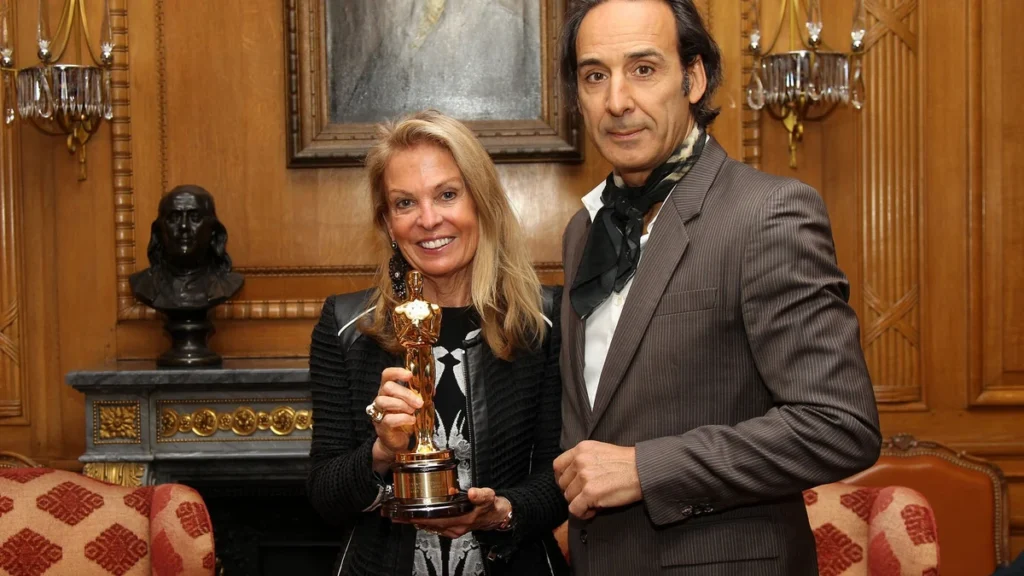
Alexandre Desplat, right, at a United States Embassy reception.
Alexandre Desplat, right, at a United States Embassy reception.
Alexandre Desplat is nominated for film composer of the year at the 26th World Soundtrack Awards, and the nomination covers four films rather than one.
They are Frankenstein, Eagles of the Republic, Jurassic World Rebirth and L’homme qui retrecit.
Four Films, Four Different Jobs
The spread across those titles is the interesting part of the nomination.
A Frankenstein adaptation is gothic, orchestral and built on dread. A dinosaur sequel is a large studio action picture with an inherited musical identity to negotiate.
Eagles of the Republic and a French adaptation of a shrinking-man story are smaller, more specific propositions again.
Doing all four in one eligibility period means writing in four registers, which is exactly what the composer-of-the-year category is designed to measure.
The Franchise Problem
Scoring a film in an established franchise carries a constraint no original film has: an existing theme the audience knows.
The dinosaur series in particular has one of the most recognisable themes in modern cinema, and any new score has to decide how much of it to use.
Too much and the score is a covers record. Too little and the audience feels the absence without being able to name it.
A Frankenstein Score Has Its Own History
Frankenstein adaptations come with a musical tradition running back to the earliest sound horror films, and that tradition is itself part of the material.
A composer taking the story on is working against decades of accumulated expectation about what the monster sounds like.
The productive route is usually to score the tragedy rather than the horror, which is what the source material supports and what most film versions have historically avoided.
Working in Two Languages
Desplat has worked continuously across French and English-language cinema, which is unusual at his level.
The two industries operate differently. French productions typically give a composer more time and a smaller budget; American studio films reverse both.
Moving between them requires adapting to different schedules, different orchestral resources and different expectations about how much music a film should contain.
Two Academy Awards Behind Him
He has won two Oscars for original score, for The Grand Budapest Hotel and The Shape of Water.
Both are scores with a strong and unusual identity: one built on Eastern European folk instrumentation, the other on a French-inflected romanticism with water imagery running through the orchestration.
Neither is a conventional Hollywood score, which is a useful corrective to the assumption that a prolific studio composer is necessarily a generic one.
The Ghent Ceremony
The 26th World Soundtrack Awards take place on 10 October at the Music Centre De Bijloke in Ghent, as part of Film Fest Gent.
The event pairs the awards with a concert, so nominated scores are performed live rather than only announced.
That format is rare and it changes what the evening is. Film music heard in a hall without the picture is a genuinely different experience.
The Category This Year
The other nominees are Hildur Gudnadottir, Daniel Pemberton, Max Richter and Jonny Greenwood.
Between them they cover orchestral scoring, electronics, minimalism and experimental string writing, which makes the category a reasonable map of the field.
It also means the award is comparing methods rather than works, which is inevitable when a nomination covers several films.
Volume as a Professional Position
Desplat has scored an unusually large number of films, and prolific output is often held against composers on the assumption that quantity dilutes quality.
The counter-argument is that scoring is a craft trade as much as an art, and craft improves with repetition rather than with scarcity.
The composers who work constantly are also the ones who develop the fluency to solve unusual problems quickly, which is what studio production actually requires.
Why Ghent Announces in Waves
The awards released a first set of nominations in August with a second wave scheduled for early September.
Staggering the announcement extends the coverage window ahead of the October ceremony, which is a straightforward publicity calculation.
It also allows categories with different eligibility periods to be handled separately, which matters when the field includes television and games alongside film.
What a Composer-of-the-Year Award Measures
Most film music awards judge a single score. A composer-of-the-year award judges a body of work across a year.
That rewards a different profile: consistency, range and the ability to serve very different films rather than one exceptional result.
It is arguably a fairer measure of the job, since a composer’s professional reality is a slate rather than a masterpiece.
The French Orchestral Tradition
Desplat’s writing draws audibly on a French orchestral lineage: clarity of texture, prominent woodwind and harp, and a preference for colour over mass.
That is a distinct alternative to the Germanic and Romantic vocabulary that dominates American film scoring.
It is one reason his scores are identifiable even across wildly different films, and why directors seeking something other than the default reach for him.
What a Franchise Theme Is Worth
An established franchise theme is a commercial asset before it is a musical one, and studios treat it accordingly.
It functions as branding: four notes that identify the property instantly, work in a trailer with no context, and carry twenty years of audience memory into a new film for free. No amount of new writing produces that.
The constraint this places on an incoming composer is real. The theme has to appear, it has to appear at the moments the audience is expecting it, and it cannot be reharmonised so far that it stops doing its job.
What is left is everything around it, and that is where a franchise score is actually judged. The best of them build new material that earns the moment when the familiar theme finally arrives, rather than simply quoting it every fifteen minutes.
Writing to Picture Under a Studio Schedule
The practical constraint on a studio composer is not creative, it is temporal, and the amount of time available has shrunk steadily for two decades.
A film’s edit is frequently still changing when scoring begins, which means cues are written to a version of a scene that will not exist by the time the score is recorded. Every change of a few frames ripples through the timing of everything written for that sequence.
Recording sessions are booked long in advance because orchestras and scoring stages cannot be moved, so the deadline is fixed regardless of whether the picture is locked.
Composers who work at volume survive this by building teams and systems around themselves, and by developing the ability to write quickly to a brief that keeps moving. That is a craft skill, and it is the one the industry actually pays for.
What Is Actually Being Tested
Two things. Whether a composer scoring at this volume can keep four films in one year sounding like four films rather than one approach applied four times.
And whether a franchise assignment can be made to sit alongside a literary adaptation in the same nomination without one of them looking like work for hire.
There is also a question about the category itself. Judging a year of work rather than a single score rewards breadth, but breadth is easier for composers working at studio volume than for those making one film every two years, which builds a structural preference into the award.
Four films, two languages, a monster, a dinosaur, and a category that judges the year rather than the score.
About The Author