Terri Lyne Carrington Made Trip the Night Fantastic a Dance Record
6 min read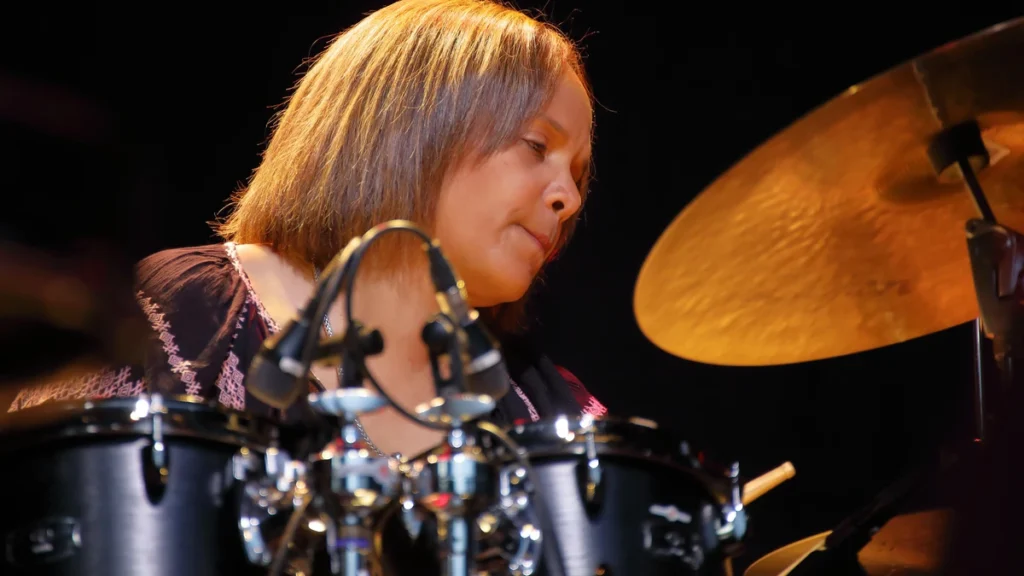
Terri Lyne Carrington performing at the drums.
Terri Lyne Carrington performing at the drums.
Seven years between albums, one band, and a record built to move to. Trip the Night Fantastic arrived on 31 July via Candid Records, the second album from Terri Lyne Carrington’s group Social Science.
The first, Waiting Game, came out in 2019 and was nominated for a Grammy. The gap between them is the first thing to note, and the second is that the follow-up is a groove record rather than a statement piece dressed as one.
A Band, Not a Session
Social Science is a standing group rather than a one-off billing, and the personnel reflect that. Jazz Desk’s review lists pianist Aaron Parks, guitarist Matthew Stevens and harpist Brandee Younger among the instrumentalists, with multi-instrumentalist Morgan Guerin in the core line-up.
That is a serious jazz band playing what the same review calls seductive, melodic soul music. The distinction matters. Jazz musicians playing soul often produce jazz with a backbeat; this is arranged as soul, with jazz players executing it.
Carrington is a multiple Grammy winner and, as the review puts it, a musician who succeeds in whatever genre she chooses. A drummer leading a groove-first record is not a stretch.
The Guest List Is the Arrangement
The vocal cast is unusually large for a jazz release: Lizz Wright, Michael Mayo, Ledisi, Moor Mother, Kokayi and Christie Dashiell across sung and spoken-word parts.
On a record with this many voices, the guests are not features in the pop sense. They function as instrumentation, with different singers carrying different pieces, which is how a drummer-led album maintains variety across a full running order.
It also spreads the album across audiences. A listener who follows contemporary soul, one who follows spoken word and one who follows jazz all have an entry point.
What the Songs Address
The subject matter is broader than on the previous album. Jazz Desk notes that Waiting Game focused on the Black Panther movement, while the new record takes in climate change, women’s rights and immigration.
The reviewer reads the album as a response to the current political situation in the United States. That is the reviewer’s framing rather than a claim the record makes in those words, and it is worth separating the two: what is verifiable is the subject matter, not a single political intent behind it.
The lyrics are direct. On Autonomy Song, quoted in the review, the words include “It’s my body and I do what I want with it” and “Get your foot off my neck”, addressing restrictions on access to abortion.
Identity Song and What Carrington Said About It
The single Identity Song, released ahead of the album, is the clearest statement of method. FEMMUSIC reported it as an alternative R&B track featuring vocalist Michael Mayo, emcee Nappy Nina and harpist Brandee Younger, addressing gender and queer identity.
Carrington explained the impulse in terms of her teaching. “As a teacher, I encounter a lot of young people who are choosing not to stay within the binary when it comes to gender identity,” she said, adding that the topic is part of current cultural and political conversation, that many people reject it, and that the struggles involved are real.
She is the founder and artistic director of the Berklee Institute of Jazz and Gender Justice, which is the institutional context for that perspective.
Younger’s comment on the track is about craft rather than politics: “‘Identity Song’ feels really special because the music itself embodies the message.” That is the line that explains why the album works as music rather than as messaging.
Why Making It Danceable Is the Point
Records built around social subject matter usually adopt a register to match: sparse, serious, slow. This one does the opposite, and the choice is deliberate.
A groove record reaches listeners who did not come for the subject matter. Someone playing an album for the rhythm section encounters the lyrics anyway, which is a wider distribution than a record that announces its seriousness in its first thirty seconds.
The risk is the obvious one: that the pleasure of the arrangement flattens the content. Reviews have consistently said it does not, with Jazz Desk describing the result as irresistible and other coverage noting that the activism is not treated as decoration.
A Drummer’s Record, Structurally
Bandleader records tend to sound like the leader’s instrument, and this one is no exception. A drummer building an album around grooves is putting the rhythm section in the foreground by default, with everything else arranged around it.
That is why the guest vocals work as instrumentation rather than as showcases. On a singer’s album the arrangement serves the voice; here the voices arrive into an existing rhythmic structure and have to fit it.
The presence of a harp in that structure is the detail that complicates the picture. Brandee Younger’s instrument sits awkwardly in most groove contexts, and building parts for it into a rhythm-led record is a compositional choice rather than a texture added at the end.
Spoken Word as a Third Register
The record uses three vocal modes: sung soul, rapped verses and spoken word. Most albums pick one and treat the others as guest moments.
Using all three lets the album change how directly it addresses the listener without changing the music underneath. A sung line carries a sentiment; a spoken line carries an argument, and the same groove can support either.
It is also the clearest inheritance from the jazz tradition the record sits in, where spoken text over rhythm has a long history rather than being a recent import from hip-hop.
Where a Record Like This Sits Commercially
Candid is an independent jazz label with a long catalogue, and a release like this is not built for a chart week. It is built to accumulate.
The mechanics resemble what we examined when looking at how streaming came to account for roughly seventy per cent of recorded music revenue. For an independent jazz release, the long tail is the business: the record stays available, the guest names bring in listeners from adjacent catalogues, and the album keeps earning years after release.
The large guest list is commercially useful for exactly that reason. Each contributor’s own audience represents a route into the record that does not depend on jazz coverage.
Two Albums, Seven Years
Social Science has now produced two albums in seven years, which is a slow rate for a working band and a normal one for a project that convenes around a subject.
The first record narrowed its focus to one movement; the second widened it to several. That progression suggests the group is a vehicle Carrington returns to when there is a body of material for it, rather than an ongoing concern with a release schedule.
On that reading the seven-year gap is not a delay. It is how long it took for there to be a second album’s worth of reason to make one.
What to Listen For
Three things. Whether the record holds together as a listening experience given how many voices pass through it. Whether the groove and the text stay in balance across a full running order rather than in isolated tracks.
And whether a jazz drummer’s soul album finds the audience outside jazz that its construction is clearly reaching for.
Two albums, seven years, one standing band and a guest list long enough to be an arrangement in itself.
About The Author