Pat Metheny Side Eye III Pairs Him With His Third Young Trio
5 min read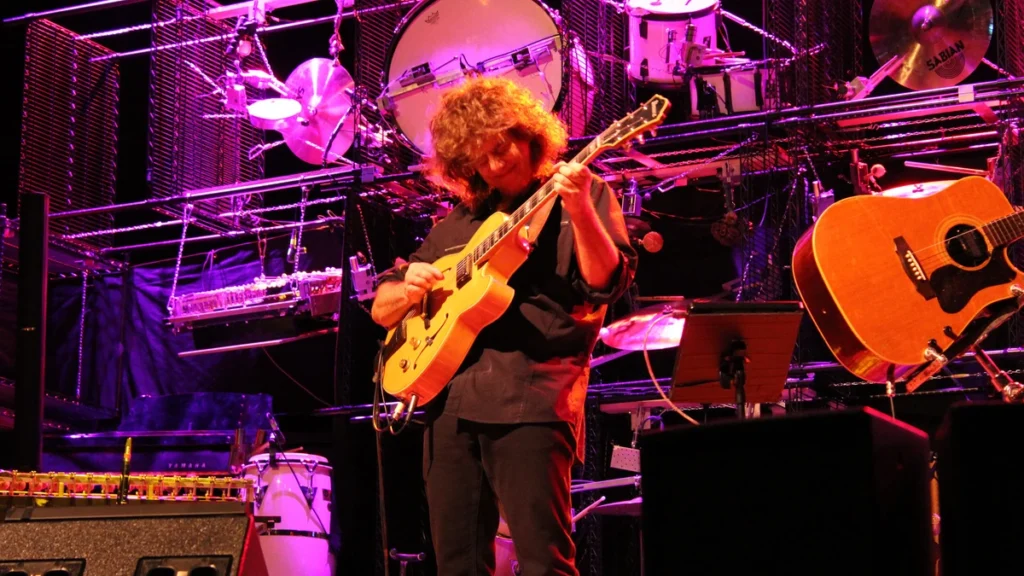
Pat Metheny performing in Florence.
Pat Metheny performing in Florence.
Three trios, two records, one guitarist. Pat Metheny Side Eye III arrived in February as the second recorded instalment of a project whose entire premise is that the band around him keeps changing.
The rotation is not incidental. It is what the series is for.
A Project Built to Hand Over Opportunities
The Jazz Mann’s review sets out the idea plainly: Side Eye sees Metheny, now a comparative elder statesman, linking up with younger, emerging musicians in order to give something back.
Metheny has explained the motivation directly. “I was given so many great opportunities by Gary Burton, Steve Swallow and all those guys and I said I’m going to do that too,” he told Jazzwise.
That is an unusually explicit statement of intent for a working band, and it explains a line-up that would otherwise look unstable. A group designed to introduce players is supposed to turn over.
Three Line-Ups Since 2021
The sequence is documented. The first Side Eye recording, with keyboard player James Francies and drummer Marcus Gilmore, was released in 2021. A touring line-up followed with Francies and Joe Dyson.
Chris Fishman then took over from Francies for the European leg of that first tour and has remained since, which makes the current trio the third edition of the core group.
Francies has not disappeared entirely: he appears on one track of the new record, playing organ. That is a neat way of acknowledging the lineage without reassembling the earlier band.
The Cast Is Much Larger Than a Trio
Despite the trio framing, the personnel list is long. Alongside Metheny on guitars, sounds and synths, Fishman on keyboards, piano and organ, and Dyson on drums, the record adds bassist Daryl Johns, harpist Brandee Younger, percussionist Luis Conte, accordionist Vincent Peirani and vocalist Leonard Patton.
A substantial group of additional vocalists appears as well, including Mark Kibble, Natalie Litza, Kim Fleming, Joel Kibble and Armand Hutton among others.
That scale is why reviewers have reached for words like big-canvas. A trio record with a harp, an accordion and a vocal ensemble on it is a trio only in its organising principle.
Fifty Years of Consistency
The Jazz Mann describes Metheny as a musician who has been consistently creative for over fifty years, and notes he is an outrageously youthful seventy-two.
The review also concedes something most career overviews avoid: that his back catalogue is so vast and so varied that a summary is impractical. That is a meaningful admission about an artist whose discography spans small-group jazz, large ensemble work, solo guitar and electronics.
It also frames why Side Eye exists. A musician with that much catalogue behind him has little to prove with another quartet record, and a mentoring project is a use of standing rather than a demonstration of it.
What the Plus Sign Is Doing
The title carries a plus after the numeral, and the personnel explain why. A record billed as the third Side Eye edition that then adds a harpist, an accordionist, a percussionist and a vocal ensemble is no longer describable as a trio album.
The additions are not decorative. An accordion and a harp both occupy the mid-range where a guitar and a keyboard already sit, so including them forces the arrangements to make space rather than simply layering texture on top.
That is the difference between an expanded edition and an expanded conception. The plus is doing work the numeral cannot.
Two Roles at Once
Metheny is playing two parts on this record: bandleader and mentor. Those pull in opposite directions more often than the framing admits.
A bandleader wants the strongest possible performance and reaches for players who need no direction. A mentor deliberately chooses musicians who are still developing, and accepts what that costs.
The reviews suggest the tension resolves in favour of craft, which implies the younger players are being chosen for readiness rather than for potential. That is a meaningful distinction: it makes Side Eye a platform rather than a workshop.
How It Was Received
Reception has been solid rather than ecstatic, which for a series entry is the expected outcome. The Jazz Mann called it an immaculately crafted album filled with impeccable playing and typically intelligent writing, while noting personal reservations about it not thrilling as much as earlier records.
Jazzwise gave it four stars out of five, writing that age is not withering him. JazzWax was warmer, placing it in the same league as Letter From Home and calling it an exceptional big-canvas work with many moods and instrumental configurations.
The consistent note across all of them is craft. Nobody is arguing the record breaks new ground; the argument is about how well it does what it does.
Fifty Years of Catalogue Behind It
The scale of the back catalogue is part of why a project like this can exist at all. A musician with a smaller body of work has to use each release to establish something; one with fifty years behind him can afford a record whose purpose is partly other people’s careers.
That freedom is rare and it is worth naming. Most jazz musicians never reach a point where a release carries no commercial pressure, and the ones who do usually spend it on solo records or on revisiting their own material.
Spending it on a rotating cast of younger players is a different use of the same latitude, and it produces a discography entry that documents a scene rather than a self.
Why the Format Suits a Veteran
A rotating band solves a specific problem for a long-career musician. A fixed group develops shared habits, which produce cohesion at first and predictability later.
Bringing in different players forces the leader to re-explain the material each time, and material that has to be re-explained tends to get re-examined. That is a practical reason mentoring projects often produce better records than their charitable framing suggests.
It also transfers something concrete. A young musician on a Metheny record acquires a credit that changes what work is available to them, which is the substance behind the phrase about giving back.
Releasing It Himself
The record came out on Metheny’s own imprint rather than through a major jazz label, which is increasingly common for established artists with a defined audience.
The economics are straightforward. An artist who can reach his own listeners directly keeps a far larger share of the revenue, and the marketing a major label adds matters less when the audience already knows the name.
It is the same pattern we examined in looking at how streaming came to account for roughly seventy per cent of recorded music revenue: when distribution no longer requires a label’s infrastructure, the reason to sign shrinks to marketing and advances.
What Comes Next for the Series
The tour supporting the album has run through spring and summer and continues into the autumn, which is a long routing for a jazz release and suggests the project is treated as ongoing rather than as a one-off.
On the evidence so far, each instalment introduces a different set of players and produces a different-sounding record. Two albums and three trios in five years is a working rate for a project that is explicitly about turnover.
The interesting question is whether a fourth line-up follows, and whether the series ends up being remembered for the records or for the careers it started.
About The Author