
Orville Peck Mule Arrives With a Man Turned Mule Tour
6 min read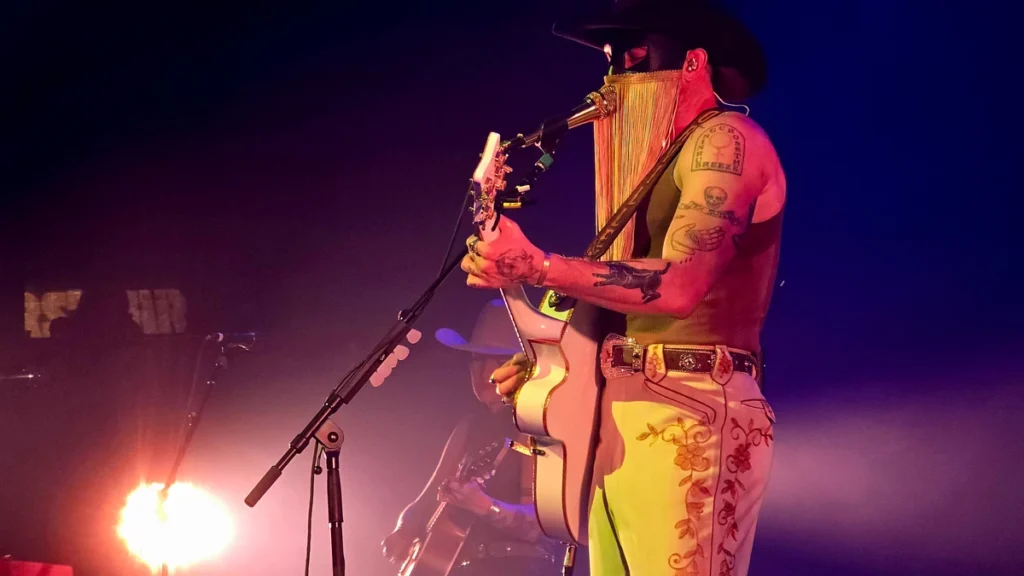
Orville Peck performing at the Roundhouse in London.
Orville Peck performing at the Roundhouse in London.
Orville Peck Mule arrives on 18 September through Warner Records, and it is the most direct record he has made.
The thirteen tracks deal with his struggle with addiction, his pursuit of sobriety and the work of rebuilding afterwards. For an artist whose public identity has been built around a mask, that is a substantial change in posture.
The Mask and the Subject Matter
Peck has performed in a fringed mask since he began releasing music, and the anonymity has always been part of the proposition rather than a gimmick attached to it.
A record about addiction and recovery is the least concealed thing an artist can make, which places the two elements in direct tension.
That tension is arguably the point. The mask was never about hiding the material; it was about controlling how the person delivering it is seen, which is a different kind of privacy.
Making the most personal record of his career while still masked is a coherent position rather than a contradiction, and it is one very few performers are set up to take.
Jay Joyce in the Producer’s Chair
Jay Joyce produced the album, which is a significant Nashville credit rather than an outsider choice.
Joyce has worked across mainstream country for years and his records tend to have more edge and more space than the format usually allows.
Hiring an established Nashville producer rather than an indie or alternative one is consistent with where Peck has been moving. His last two records have sat closer to the country mainstream than the earlier work did.
The Opening Track Is a Statement
“Prologue (Eulogy of a Man Turned Mule)” features Emmylou Harris, Noah Cyrus and Allison Russell, and its placement as track one is deliberate.
Emmylou Harris appearing on the opening song of a record about addiction carries weight that no amount of promotion could buy. Her presence functions as an endorsement from the tradition itself.
Allison Russell is one of the most decorated recent voices in Americana, and Noah Cyrus has spent the last several years building a serious country-leaning catalogue.
Three guests on one track is unusual, and reading it as a chorus rather than as three features makes more sense of the arrangement.
What the Title Refers To
A mule is a working animal bred for endurance rather than speed, unable to reproduce, valued entirely for what it can carry.
As a metaphor for a person worn down by function it is unambiguous, and the prologue title spells it out: a eulogy for a man turned mule.
Titles that literal are risky. They remove interpretive room and leave the songs to carry the weight, which is presumably the intention on a record about being honest.
Thirteen Tracks and What They Are Called
The tracklist reads as a sequence rather than a collection: “Big Ol’ House”, “Already Gone”, “Rehab Blues”, “Ring the Bell”, “Blue Skies”, “The Fall”, “Cowboy Heart”, “The Breeze, The Grass, The Mourning Dove and Me”, “Run Out of Road”, “Too Little, Too Late”, “War of the Worlds” and the closing “Mule”.
“Rehab Blues” and “Ring the Bell” sit in the first half, and “Run Out of Road” and “Too Little, Too Late” arrive near the end.
Whether that ordering traces a narrative arc is a question for the listening, but the titles are not arranged randomly.
The Lead Single Was Co-Written
“Too Little, Too Late” was written with Dan Wilson and Steve Rusch.
Dan Wilson is one of the most successful songwriters working, with a catalogue of collaborations across pop, country and rock.
Bringing in writers of that calibre on a record this personal is a specific decision. Co-writing about your own addiction requires trusting someone else with the material, which is harder than writing alone.
Country Music and Queer Artists
Peck occupies a genuinely unusual position: an openly gay artist working in traditional country rather than adjacent to it.
The genre’s institutions have historically been unwelcoming, and the assumption for years was that a country career and a queer public identity were incompatible.
What has shifted is not primarily the institutions but the audience, and Peck’s career is the clearest single piece of evidence for that. He has built a following inside country’s live circuit rather than outside it.
A Dollar Per Ticket to The Trevor Project
The Man Turned Mule Tour donates one dollar from every ticket to The Trevor Project, which provides crisis intervention and suicide prevention services for LGBTQ young people.
Per-ticket donations are a common structure and their value depends entirely on scale. Nineteen dates across theatre-sized venues produces a meaningful sum without requiring anything of the audience.
It also connects the charitable element to the record’s subject matter, which is a more coherent pairing than most tour philanthropy manages.
Nineteen Dates in Under a Month
The tour runs from 28 October to 22 November, which is a compressed routing for nineteen shows across North America.
Touring at that density is physically demanding, and for an artist making a record about recovery the road is a specifically difficult environment.
Abbie Callahan supports across the run, and three larger standalone shows precede it in September, including the Hollywood Bowl on release day.
Releasing on the Night of a Hollywood Bowl Show
Playing the Hollywood Bowl on 18 September, the day the album comes out, is a scheduling decision that says something about confidence.
Release day is usually spent on promotion rather than on stage, because a show consumes the day entirely.
Choosing to spend it in front of an audience of that size instead treats the record as something to perform rather than something to publicise.
The Year Peck Had Before This
The album follows a period of substantial activity outside music. Peck made his Broadway debut in Cabaret in 2025 and has since wrapped filming on a Street Fighter adaptation, playing the masked character Vega.
Both roles are consistent with his existing practice. Cabaret is a piece about performance and concealment, and a masked film character needs no explanation.
He also released the Appaloosa EP in November 2025, so the gap since 2024’s Stampede has not been quiet.
Warner Records and the Major-Label Position
Mule is a major-label release, which places it inside country’s commercial infrastructure rather than in the Americana margins.
That matters for how the record is worked. A major has radio relationships, retail placement and a promotional budget that an independent cannot match.
It also means the album is expected to perform, which is a different pressure from the one an artist faces making a personal record on a small label.
Recovery Records and Their Difficulty
Albums about addiction have a long history in country music and a specific failure mode: they can become testimony rather than songwriting.
The material carries so much inherent weight that the craft can go unexamined, and the audience responds to the disclosure rather than to the songs.
The way through is specificity. Records that survive are the ones that describe particular days rather than general states, and the tracklist here suggests Peck knows that.
What Is Actually Being Tested
Two things. Whether a persona built on concealment can carry material this direct without one undermining the other.
And whether the country audience that has taken to Peck over three albums follows him somewhere considerably darker than Stampede went.
Thirteen tracks, a Nashville producer, Emmylou Harris on the opening song, nineteen dates, and an artist writing about the thing the mask was never actually hiding.
About The Author