
Ky-Mani Marley Ends a Ten-Year Album Gap With Love and Energy
6 min read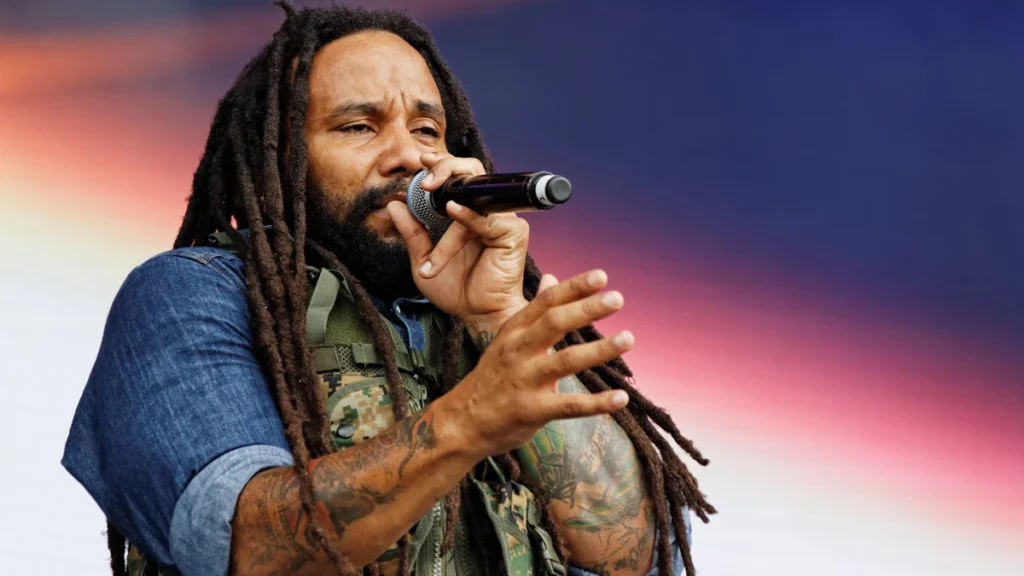
Ky-Mani Marley performing at Festival des Vieilles Charrues.
Ky-Mani Marley performing at Festival des Vieilles Charrues.
Ky-Mani Marley released Love & Energy on 28 August, and the interval is the first thing worth stating plainly: it is his eighth studio album and his first full-length record in ten years.
Ten years is a long time in any genre. In reggae, where the singles economy moves fast and the album is often treated as a formality, it is long enough for an artist to be defined entirely by their catalogue rather than by anything new.
Sixteen Tracks and a Full Guest List
The record runs sixteen tracks, which is a substantial length for a reggae album in an era when most releases land between nine and twelve.
The guest list is equally full. Sizzla, Gyptian, Agent Sasco, Anthony B, Bugle and Andrew Tosh all appear, with Iba Mahr and Lutan Fyah featured on the title track itself.
That is not a set of features chosen for streaming reach. Every name on it is a working reggae or dancehall artist with a defined position in the music, which suggests the album was assembled from relationships rather than from a marketing list.
What a Ten-Year Gap Actually Means
An album gap of this length usually indicates one of three things: a label dispute, a shift in priorities, or a decision that there was nothing worth releasing yet.
In Ky-Mani Marley’s case the touring never stopped, which rules out disappearance. He has remained a festival fixture across Europe and North America throughout the period.
What a gap like that does is remove the release calendar as a constraint. An artist who is not obliged to deliver every eighteen months can wait until the material is ready, and the sixteen-track length here suggests it accumulated rather than being written to order.
The Label Arrangement
The album arrives through Konfrontation Muzik Group in partnership with Dubshot Records. Neither is a major, and that matters for how the record will be worked.
Independent reggae releases live and die on catalogue longevity rather than on release-week performance. There is no radio push to fund and no chart position being defended, so the album is expected to earn out over years.
That model suits an artist with a durable touring base, which is exactly what a decade of continuous live work builds.
New Creature Went to Number One
The single “New Creature” reached number one on the Jamaican charts ahead of the album, which is a meaningful result for a lead track from a long-delayed record.
A domestic number one in Jamaica is a different signal from an international streaming figure. It indicates the record has traction in the market that judges reggae most closely, which is not guaranteed for any artist returning after a decade.
It also gave the album a live single before release, so the record did not arrive cold.
The Title Is a Statement of Method
Marley has framed the title directly. “Love & Energy isn’t just an album title,” he said. “It’s a way of life.”
He described love as “the highest vibration we can give and receive,” which places the record in the roots-conscious tradition rather than in the dancehall lane where several of his guests operate.
Reggae has always carried that kind of framing without irony, and it is one of the few genres where a statement like that reads as a thesis rather than as marketing copy.
Carrying the Surname
Being a Marley is a complicated inheritance. The name guarantees a hearing and simultaneously guarantees that every record will be measured against a catalogue nobody can match.
Ky-Mani has spent his career building a body of work distinct enough to be discussed on its own terms, moving between reggae, hip-hop and rock across earlier albums rather than staying inside a single tradition.
The guest list on Love & Energy reads as a decision to sit firmly inside the Jamaican music community on this one, rather than reaching outward for crossover names.
A Full Touring Year Around the Release
The album did not arrive in isolation. Marley completed a European touring leg including Summerjam in Cologne, and appeared at Kaya Fest in Toronto on 22 August alongside Stephen, Julian and Damian Marley, Busta Rhymes, Shabba Ranks and Lila Iké.
Scheduling a festival appearance of that scale six days before a release date is deliberate. It puts the artist in front of a large audience with the record about to land.
It also placed him on a bill with three of his brothers, which is its own kind of statement for a record released after ten years away.
Where the Album Sits Stylistically
The track titles suggest range rather than a single mode. “War Inna Babylon” features Sizzla, Gyptian and Agent Sasco, which points to the harder conscious material. “Miss Electric,” “City Views,” “Love Is Key” and “Breathe” suggest a softer register.
“A Little Bit (I’m Okay)” and “All This Love” were released ahead of the album, giving listeners two points of reference before the full sequence arrived.
A sixteen-track album with that spread is asking to be heard as a body of work rather than as a playlist feed, which is a defensible choice after a decade.
Reggae’s Album Problem
The genre has a structural difficulty with albums. Reggae and dancehall have historically run on singles, riddim compilations and sound-system culture, all of which reward the individual track.
Streaming has intensified that. Playlists are the primary discovery mechanism, and playlists consume singles.
Releasing sixteen tracks into that environment is a deliberate refusal of the format’s logic. It works if the audience treats the artist as a catalogue proposition rather than a track supplier, which a decade of touring tends to establish.
The Company He Kept on This Record
The features are worth reading individually, because each one carries a different lineage. Sizzla and Anthony B are both products of the mid-nineties conscious revival, artists who came up when reggae was reasserting Rastafari themes against the dancehall of the moment.
Agent Sasco, who recorded for years as Assassin, sits on the dancehall side and has one of the sharpest deliveries in the form. Gyptian arrived later with a lovers-rock lean that gave him one of the genre’s biggest international singles.
Andrew Tosh brings a second-generation connection of his own, and Bugle has spent the last decade as one of the more reliable album-quality voices in Jamaican music. Iba Mahr and Lutan Fyah, on the title track, are both roots singers with long independent catalogues.
Put together, that is a cross-section of thirty years of Jamaican recording rather than a set of names chosen for reach. It reads as a record made inside a scene.
Why the Release Week Was Chosen
Late August is not an accident. It sits at the end of the European festival season, when a reggae artist has just spent three months in front of the audience most likely to buy the record.
It also lands well clear of the fourth-quarter release crush, when major-label albums crowd every playlist and every editorial slot. An independent reggae album released in November is competing for attention it cannot win.
For a catalogue-driven release, the calendar question is not which week produces the biggest first seven days. It is which week gives the record the longest clean runway before the noise starts.
What Is Actually Being Tested
Two things. Whether a ten-year absence from albums reads as patience or as drift, which the sequencing will answer more than any individual track.
And whether a guest list drawn almost entirely from inside Jamaican music broadens the record or narrows it. Features can build an album or dilute it, and eight of them across sixteen tracks is a high ratio.
An eighth album, ten years on from the seventh, sixteen tracks deep, made with the people the artist already works alongside.
About The Author