
Kim Petras Detour Is Her First Independent Album in Six Years
6 min read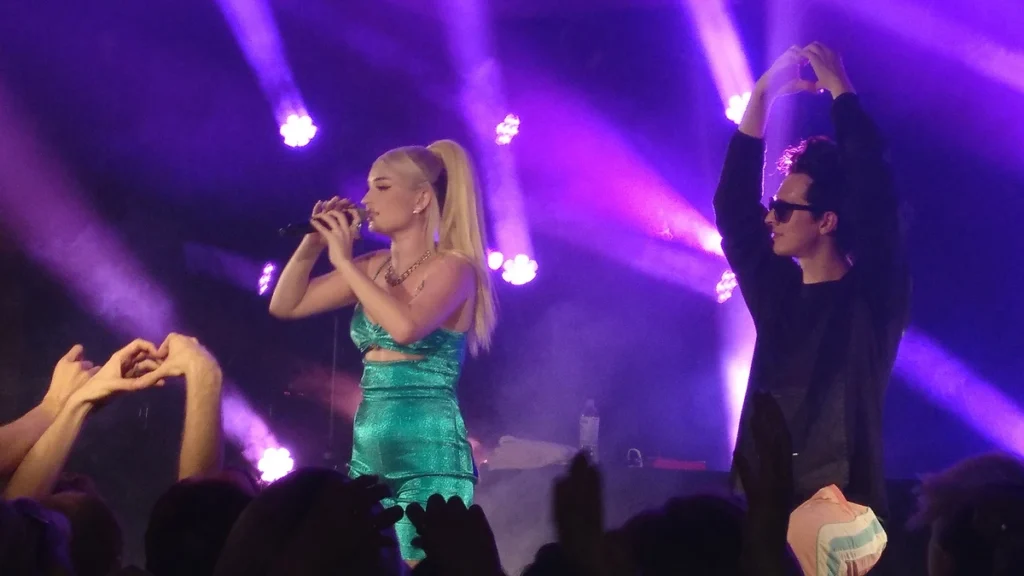
Kim Petras performing on the Clarity Tour.
Kim Petras performing on the Clarity Tour.
Kim Petras Detour arrived on 29 May through BunHead Records and Amigo. It is her first independent release in six years, and the circumstances behind it are unusually public.
In January she asked Republic Records to release her from her contract, alleging that the label had sat on a finished album and its singles.
The Public Request to Be Released
Artists almost never make a label dispute public while still signed, because the cost of doing so is high and the leverage is usually low.
Petras alleged specifically that a self-funded video for “Need for Speed” had gone unreleased for over two months, which is the kind of detail that makes a general complaint concrete.
Going public is a calculated move. It converts a private negotiation into a reputational question for the label, and it works only when the audience is likely to side with the artist.
She got out, and the album came through her own imprint four months later.
Six Years Since the Last Independent Release
Her last independent release was in 2020, which means the entire major-label chapter sits between then and now.
That period produced a record that did not perform, and the aftermath is visible in what she chose to do next.
Returning to independence after a major-label deal is not a step backwards in the current market. For an artist with an established audience, it usually means keeping considerably more of the revenue.
Hyperpop Producers Rather Than Pop Ones
Petras worked with Frost Children, Margo XS and Nightfeelings, all of whom sit in the hyperpop and internet-pop world rather than in mainstream pop production.
That is a deliberate change of company. Major-label pop production optimises for radio and playlist compatibility, and the producers who do it well are a small and identifiable group.
Hyperpop producers optimise for something else: density, distortion, sudden structural changes and a general refusal of polish.
Choosing them is the clearest signal that the record was not made to satisfy the machinery she had just left.
What She Said in Advance
Speaking to Paper in 2024, Petras described the material as “definitely going to be really different for me”, which turned out to be accurate rather than promotional.
Artists say that about most records and rarely mean it. In this case the production credits back it up.
Signalling a change two years ahead of release also suggests the record was finished long before it came out, which is consistent with her account of the delay.
A Track Co-Produced by Sophie
The album includes “Basketball”, co-produced by Sophie, the Scottish producer who died in 2021, from work dating to 2019.
Sophie’s production is one of the foundational influences on everything now described as hyperpop, and she worked with Petras early in her career.
Releasing a posthumous co-production seven years after the session is a considered decision rather than an archival one. It places the record explicitly in a lineage the artist actually belongs to.
Thirteen Tracks in Thirty-Six Minutes
The album runs thirteen tracks across roughly thirty-six and a half minutes, which averages under three minutes per song.
That brevity is characteristic of the genre. Hyperpop songs tend to be short because the density does not sustain, and a three-minute track at that intensity feels longer than it is.
It also produces a record that can be played end to end without effort, which is increasingly rare for an album of thirteen songs.
Five Singles Across Eleven Months
The singles ran from “Polo” in June 2025 through “Freak It”, “I Like Ur Look” and “Need for Speed” to “Jeep” in May 2026.
Five singles across eleven months is a long campaign, and the gaps between them are uneven, which is consistent with a release schedule that was not fully under the artist’s control.
The final two arrived within six weeks of each other in spring, immediately after the label situation resolved.
The Reviews Were Strong
Pitchfork rated the album 7.6 and described it as her true artistic debut, which is a pointed thing to say about a third record.
Rolling Stone gave three and a half stars, Riff Magazine gave it full marks, and The Needle Drop rated it seven out of ten.
The consistency matters more than any individual score. A record that divides critics usually gets a wide spread, and this one did not.
Modest Chart Numbers
The commercial performance was smaller: number fifteen on the US Top Dance Albums chart, fifty-one on UK album downloads, sixty-four in Australia.
Those are not mainstream pop numbers, and they were never going to be for a self-released hyperpop album with no major-label promotion behind it.
The relevant question for an independent release is margin rather than position. A record selling modestly through an artist-owned imprint can return more than a larger-selling one on a major.
What the Title Means Here
Calling the album Detour frames the last several years as a departure from a route rather than as the route itself.
That reading places the major-label period as the deviation and the current independent, hyperpop-facing work as the return.
Whether that is how the career will look in a decade is unknowable, but as a statement of intent it is unambiguous.
Brutalism as a Reference Point
One track, “Brutalist”, takes its inspiration from a specific building: the Post-Pyramide in Hamburg.
Referencing a particular piece of architecture rather than a general aesthetic is the kind of specificity that separates a considered record from a stylistic exercise.
It also fits the production. Brutalism is an architecture of exposed structure and refused ornament, which is a reasonable description of what hyperpop does to a pop song.
The Economics of Leaving a Major
Departing a major label is usually presented as a loss of resources, and in terms of marketing spend it is.
What it returns is control of timing and a far larger share of income per unit sold. An artist with a defined audience and a functioning direct channel can make that trade profitably.
The condition is that the audience has to already exist. Petras spent the major-label years building one, which is what makes the independent move viable now.
Why Labels Sit on Finished Records
The allegation at the centre of the dispute is one of the most common complaints in the industry and one of the least visible from outside it: a label holding a completed album rather than releasing it.
It happens for reasons that are rational from the label’s side and maddening from the artist’s. Release calendars are managed across an entire roster, so a record can be held to avoid competing with a bigger act, or to wait for a marketing slot, or because the internal champion for the project has left.
None of those reasons is visible to the artist, who simply has a finished album and no release date. Music ages, momentum decays, and a record held for a year arrives into a different market from the one it was made for.
The imbalance is structural. The label carries the financial risk and therefore controls the timing, and the artist carries the career cost of a delay they cannot influence.
Hyperpop After Its Moment
Hyperpop had a defined commercial peak that has since passed, and the genre now occupies the position most internet-born movements eventually reach: no longer a trend, permanently part of the vocabulary.
That is arguably a better environment for making a record in it. During a hype cycle, the style attracts artists who want the association rather than the sound, and the output gets diluted.
Afterwards, what remains is the people who were always going to work that way. The production techniques stay in circulation and turn up inside mainstream pop without the label attached.
An artist returning to it now is therefore not chasing a moment. She is going back to the place her career started, which is a different and more defensible reason.
What Is Actually Being Tested
Two things. Whether a hyperpop record can sustain an artist commercially at this level, or whether the genre remains a critical position rather than a business.
And whether “true artistic debut” holds up as a description. It is a generous reading of a third album, and the next record is what will determine whether it was accurate.
Thirteen tracks, thirty-six minutes, one posthumous co-production, a public exit from a major label, and an artist who went back to the producers she started with.
About The Author