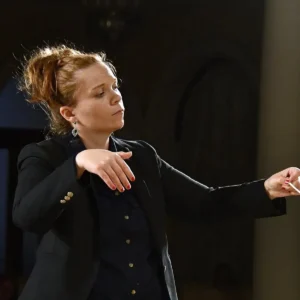
Maëla Raoult Puts Mars at the Top of Her Own Spotify Ranking
6 min read
Maëla Raoult Puts Mars at the Top of Her Own Spotify Ranking
A Clarinet, Cello and Percussion Single From Brussels Finds Jazz, Classical and Dance Listeners
Mars by Maëla Raoult holds first position in the Popular ranking on her Spotify page. It sits above her recordings of Sequenza n°IX and Mackie Messer. The single sets her clarinet against percussion, electric bass and cello, with traditional melodies that lean toward the Middle East. It came out on 4 September 2026 through Azkaban Records, the label she directs. Six weeks on, the listeners it has reached say a good deal about who it was made for.
Maëla Raoult’s Mars is in the playlist below, and her coverage is collected on the Maëla Raoult artist profile. Mars reached this desk through PopHits.Co Music Charts, which verifies independent artists and places their releases across its network of music news desks. Press play on the clarinet, then read on.


Who Maëla Raoult Made Mars For, From Jazz Clarinet Fans to Dance Floor Regulars
The first listener Mars serves is the jazz fan who wants a reed instrument out front. Raoult’s clarinet carries the melody from the start. Meanwhile, the playing moves between a lyrical, sensual line and a brighter, playful one. Her piano shares the lead, so the track keeps passing between two voices that are both hers. As a result, it never settles into one mood for long.
The second listener came for the beat. Percussion is the pulse of the record. The patterns under the clarinet are busy enough to keep a room moving. Electric bass and keyboards hold the low end and the harmony. Guitar and cello, by contrast, add colour around the edges. At just over four minutes, Mars also gives the groove time to settle and leaves space for improvised passages.
Where Fans of Jazz Built on Middle Eastern Grooves Fit In
Listeners who already own records by Ibrahim Maalouf will recognise the territory. For nearly two decades, the French-Lebanese trumpeter has set jazz improvisation against Arabic modes and dance rhythms. Mars applies a similar idea to the clarinet. Fans of the Israeli bassist Avishai Cohen have a link too. His ensemble records build on Middle Eastern melodies and driving rhythmic patterns. Raoult’s percussion section covers the same ground here.
The third audience is a classical one. Raoult was born in Brest in 1990 and trained at the Brest Music Conservatory. She then studied in Paris and at the Royal Conservatory of Brussels, graduating with distinction in 2014. Her Spotify catalogue still holds solo clarinet repertoire alongside this new jazz writing. That is why the order of her Popular list is worth reading. A dance-led single now leads a page built largely on concert music.
In short, the target listener moves easily between jazz, indie, electronic dance music, pop and classical. Mars asks for no loyalty to any one of them. Instead, it asks the listener to follow a clarinet wherever the percussion takes it.

Early Response to Mars, From College Radio in Cambridge to Music Industry Weekly
The early tally reads clearly. First, Music Industry Weekly ran a news story on the release on 8 September. It noted that Mars was available on digital platforms as well as on CD and vinyl. Then Daily Music Roll carried the announcement on 12 September. The release itself had gone out on IssueWire on release day.
Radio followed. On 6 October, Ken Field’s programme The New Edge on WMBR played Mars. It came straight after La Poupée de Machiavel, another Raoult track. WMBR is the MIT campus station in Cambridge, Massachusetts. Its playlist log lists both songs as new Azkaban Records releases. The same set also included new music from Nicholas Payton and Butcher Brown. For an independent release from Belgium, a slot on American college radio is a useful marker of where the record travels.
On Spotify, meanwhile, the signal sits on her own page. The Popular list there is driven by recent listening. So a single released in September only climbs it when people keep returning to it. Mars did exactly that, and it moved ahead of her earlier recordings.


The Community Around Maëla Raoult, From Azkaban Records to the Orchestras She Conducts
Mars also arrived with a following already in place. Raoult runs Azkaban Records, and her profiles describe her in three roles: conductor, clarinettist and music producer. Her Instagram account, followed by over 40,000 people, lists the new song in its bio. It also pins the Mars artwork near the top of the grid. On Facebook, around 22,000 people follow her page. There, the Mars mask artwork serves as the cover image, next to footage of her on the podium.
The conducting work brings its own audience. Since moving into professional conducting in 2024, she has led the Tokyo Sinfonia and the Berlin Sinfonietta. Her list also includes the Bordighera Symphony Orchestra and the State Chamber Orchestra of Azerbaijan. Listeners who found her through that work now hear her compose and produce for a seven-piece line-up. It runs from clarinet, piano and cello to guitar, electric bass, keyboards and percussion.
Still, the two followings overlap more than the genre labels suggest. An orchestra audience already knows how she shapes a phrase. Now a jazz and dance audience hears that same control applied to a groove. Mars is the record where those two groups meet.
From the BestMusic.News Curator Team: “What earns Mars its place on this desk is the clarinet line. It switches from lyrical, sensual phrasing to bright and playful runs, all held over percussion that keeps asking the room to move. A conductor wrote this, and you can hear the structure under the improvisation.”
Where to Hear Mars by Maëla Raoult and Follow Her Across Streaming and Social Platforms
Every major service carries the single, so pick the one you already use. Stream Mars on Spotify, Apple Music, Amazon Music, SoundCloud and YouTube Music, or save it on your preferred platform.
Follow Maëla Raoult on Spotify, Deezer, YouTube, Instagram, Facebook, Threads and LinkedIn.















About The Author