Russian Circles Nine Marks Twenty Years of the Instrumental Trio
6 min read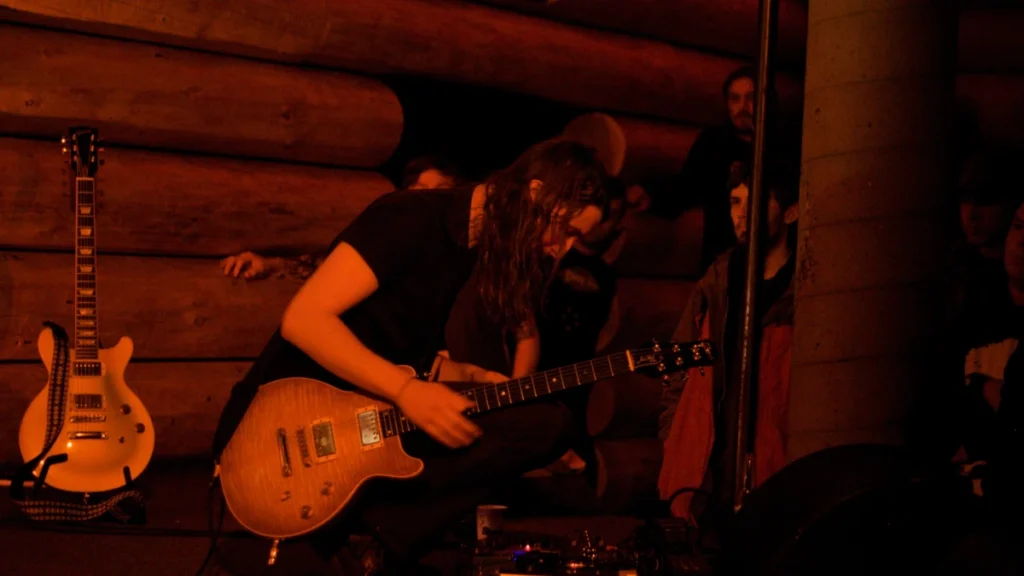
Russian Circles performing at the Doug Fir Lounge in Portland.
Russian Circles performing at the Doug Fir Lounge in Portland.
Russian Circles Nine arrived on 28 August through Sargent House. It is the Chicago trio’s ninth album and it lands as the band pass twenty years together.
The title does the arithmetic for you, which is characteristic. Russian Circles have never been a band that explains itself in words, having released nine albums without a single vocal.
Twenty Years With No Singer
An instrumental band sustaining a twenty-year career is genuinely unusual. The format removes the most direct route an audience has into a record, and most bands that try it never get past a local scene.
Russian Circles have instead built a following large enough to headline internationally, which means the audience learned to follow the music without the usual handhold.
The band reached the anniversary partway through the touring cycle for Gnosis, their eighth album, which tells you something about how they operate. The milestone arrived during work rather than being planned around.
Kurt Ballou Engineered and Mixed It
Kurt Ballou handled engineering and mixing. He is the guitarist in Converge and the operator of God City Studio, and his production is one of the defining sounds of modern heavy music.
Ballou’s records are recognisable for how physical they sound. Drums hit rather than sit, and guitars stay abrasive without collapsing into mud.
For an instrumental band, that matters more than usual. With no voice carrying the melody, the tonal decisions have to do the work a singer would otherwise do.
Two Studios, One Month
The album was recorded across Electrical Audio in Chicago and God City in Salem, Massachusetts, in March.
Electrical Audio is Steve Albini’s studio and is built around capturing a room honestly rather than constructing a sound afterwards. God City is Ballou’s own facility.
Splitting a record between those two rooms is a deliberate combination: an honest live capture at one end and a producer’s own environment for the shaping at the other.
Seven Tracks and Their Titles
The record runs seven tracks: “Borehole”, “Empath”, “Eluvial”, “E2”, “Meridian”, “Arletta” and “Seventh Seal”.
Instrumental bands carry an unusual burden with titles. With no lyrics, the title is the only linguistic information a listener gets, and it frames the piece entirely.
These are terse and mostly non-narrative, which is consistent with the band’s approach. They point at a mood rather than describing a scene.
Seventh Seal Came First
“Seventh Seal” was released ahead of the album as the lead track, which is a meaningful choice given it closes the record.
Leading with a closer is unusual. Most bands preview an opener or a mid-record peak, because those are structurally built to grab attention.
Choosing the final track suggests the band consider it the strongest statement rather than the most immediate one, and that they trust the audience to hear it out of sequence.
Sargent House and the Independent Model
Sargent House has been the band’s label home for most of their career, and the relationship is one of the more stable in independent heavy music.
The label operates as management and record company at once, which removes a layer of negotiation and allows longer artistic runs than a conventional deal usually supports.
Nine albums with essentially one label is close to unheard of at this level, and it explains why the band’s catalogue reads as continuous rather than as a series of contract periods.
Where They Sit in Heavy Music
Russian Circles get filed under post-metal, post-rock and instrumental metal depending on who is writing, and none of those labels is quite right.
The band build long dynamic arcs of the kind post-rock made familiar, but the heaviest sections are genuinely heavy in a way most post-rock avoids.
That in-between position is why they draw audiences from both sides. Metal listeners take them seriously and so do people who would not otherwise attend a metal show.
The Three-Piece Constraint
Working as a trio without a vocalist means guitar, bass and drums have to cover everything, and there is nowhere to hide when one part drops out.
The band’s solution has always been layering and loops, letting a guitar figure sustain underneath while another line moves over it, so the arrangement sounds fuller than three players should manage.
That approach also shapes the writing. Parts have to be built to interlock rather than to be stacked in a studio, because the live show has to reproduce them.
What Twenty Years Does to a Catalogue
Nine albums over two decades is a steady rather than prolific rate, and the consistency is the point. The band have never taken a long hiatus and never had a reunion, which means the catalogue reads as one continuous argument.
For a listener arriving now, that is a substantial body of work to enter, and the absence of lyrics means none of it is dated by subject matter.
Instrumental records age differently for exactly that reason. There is no cultural reference to become a period marker.
A Busy Release Friday
Nine landed on one of the most crowded days of the year for heavy music, sharing a Friday with more than sixty rock and metal releases.
Bands at this level are not competing for chart positions, so the crowding costs little. The audience for an instrumental post-metal record is specific and finds the release regardless.
What crowding does affect is press coverage, and a record with a twentieth-anniversary hook attached has a better claim on it than most.
Why Electrical Audio Is Not a Neutral Choice
Booking Electrical Audio carries a specific meaning in American independent music. The studio was built on a philosophy that a recording should document a performance rather than assemble one, and that philosophy is embedded in how the rooms are designed and how sessions run there.
Bands who record there are usually signalling that they want the take rather than the edit. That is a demanding position for any group and a particularly exposed one for a trio, because there are only three parts and every one of them is audible.
Pairing it with God City then adds the other half. Ballou’s studio is where the record gets its density and its edges, which is a different job from capturing the performance.
Recording in March and releasing in August is a five-month turnaround, which is fast for a band at this level and consistent with a record made largely live rather than constructed over a long period.
Instrumental Music and the Streaming Problem
Music without vocals sits awkwardly in the streaming economy, and the reasons are structural rather than a matter of taste.
Playlists are the main discovery mechanism, and the large editorial playlists are built around songs with hooks and words. An eight-minute instrumental with a slow build has nowhere obvious to go in that system, and the algorithmic surfaces that might catch it tend to route toward ambient and study playlists where heavy music does not belong.
The consequence is that bands like this earn from touring, physical sales and direct-to-fan channels rather than from streams. Vinyl matters disproportionately, and so does the merchandise table.
It also explains the label relationship. A company that manages and releases the same act can build around that economy deliberately instead of hoping a streaming break arrives.
The Live Question
Russian Circles’ reputation rests substantially on the live show, where the loops and layering are executed in real time and the volume does work a record cannot.
An instrumental band lives or dies on that. Without a frontperson, the performance has to hold attention through arrangement and dynamics alone.
The four-year touring cycle around Gnosis is the evidence that it works. Bands with no singer do not tour that long unless the room keeps filling.
What Is Actually Being Tested
Two things. Whether a band this far into a career can still move the form, or whether nine albums of instrumental heavy music inevitably start to reference each other.
And whether Ballou’s production pushes them further toward weight than the recent records have gone. The choice of engineer suggests an intention rather than a default.
Twenty years, nine albums, three players, no vocals, and a record cut in a month across two of the most distinctive rooms in American heavy music.
About The Author