Post Malone August 26th Reaches Streaming a Decade Late
6 min read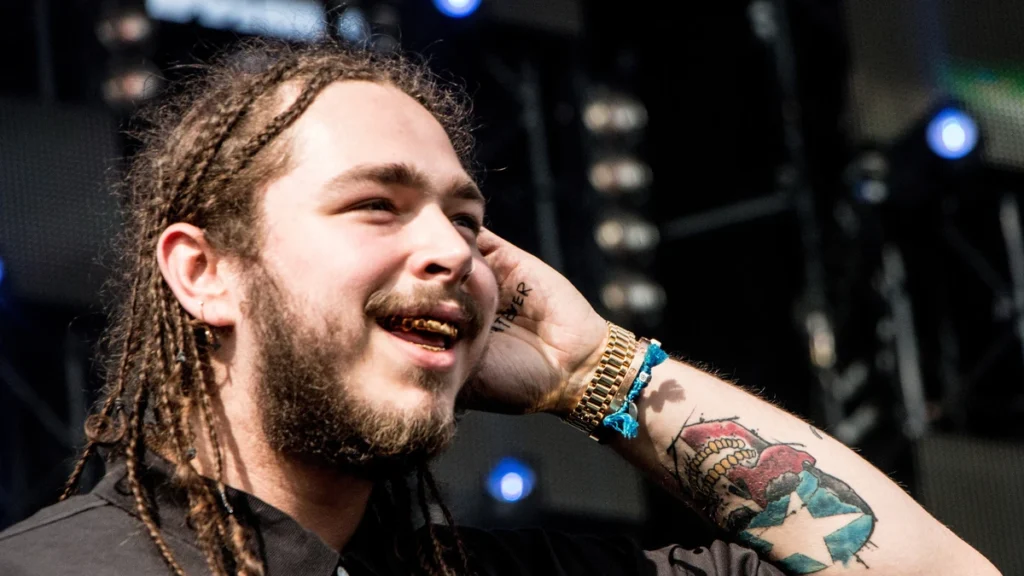
Post Malone performing in 2016, the year August 26th was first released.
Post Malone performing in 2016, the year August 26th was first released.
Ten years, and one of the most-streamed artists of the era had a full-length missing from the catalogue. Post Malone August 26th reached streaming services on 26 August, newly remastered, alongside its first ever vinyl pressing.
The gap is the story. Every other release in his discography has been available to stream for years. The one that started it was not.
A Title That Refers to a Date That Moved
The name is not a release date. It is a missed one. uDiscover Music reports that August 26th refers to the planned release date for Stoney, his debut studio album, which was postponed and eventually arrived on 9 December 2016.
So the mixtape is named after a deadline that slipped by more than three months. That detail has aged into something more interesting than it was at the time, because it dates the record precisely to the period before the artist became a fixture.
The mixtape itself came out in May 2016, following the breakthrough single White Iverson. It was his first full-length, and uDiscover describes it as a taste of the styles that would later carry him across rock, pop, hip-hop and country.
The Record That Followed White Iverson
The sequence matters. White Iverson came first and did the work of introducing him. August 26th followed it, and had to answer the question every viral debut single raises, which is whether there is a body of work behind it.
That is a harder position than it sounds. A breakout single creates an audience with no patience and no context, and the first full-length either converts that attention or loses it. In this case it converted, and the album that arrived seven months later went on to define the next phase.
Reading the mixtape now, with the rest of the catalogue already known, changes what it is. In 2016 it was a promise. In 2026 it is the earliest evidence of a style that later crossed into pop, rock and country.
The Guest List Reads Like a Snapshot of 2016
Official Charts notes that the project features team-ups with 2 Chainz, Jeremih, Lil Yachty and Jaden Smith.
That is a specific moment in time. Lil Yachty was months into his own breakout. Jeremih was coming off a run of hits. The collaborations were not the strategic, chart-engineered pairings that a major-label campaign produces now.
It was executive produced by FKi 1st, a close collaborator rather than a hired name, which is the other marker of where the record sits: made inside a small working circle, before the machinery arrived.
Why a Missing Release Matters to the Numbers
Catalogue completeness is not a trivia point. Streaming platforms reward depth, because a listener who finishes an album is routed into adjacent releases by the same artist. A missing first record breaks the earliest link in that chain.
For ten years, anyone working backwards through Post Malone’s catalogue hit a wall at Stoney. The material that preceded it existed only outside the ecosystem, which meant it accumulated no streams, contributed no catalogue units and appeared in no algorithmic routing.
Adding it now does not retroactively create those years of activity. What it does is open a new tail on a catalogue that is otherwise fully mined, at a point when the artist has a large enough audience for even a decade-old mixtape to register.
The timing is favourable in one specific way. A catalogue addition performs best when the artist is at maximum reach rather than at the moment of release, because the number of listeners available to discover it is far larger. A mixtape added in 2016 would have reached the audience of a new artist. The same mixtape added in 2026 reaches the audience of an established one.
That inverts the usual logic of release timing, where being early is an advantage. For catalogue, being late can be worth more, provided the material eventually arrives at all.
The Vinyl Is the New Part
The streaming addition is the headline, but the first-ever vinyl pressing is the part with a direct chart mechanism. A mixtape that has never had a physical edition has a buyer base that has never had the chance to buy it.
That is a different proposition from a standard reissue, where most of the audience already owns a copy in some format. Here the demand is genuinely unmet, and unmet demand is what produces a first-week figure.
Whether it converts depends on how much of the audience is invested in the pre-Stoney era specifically, rather than in the arena-scale artist who came afterwards.
There is a second effect worth noting. A first-time vinyl pressing of a ten-year-old mixtape is a collector proposition, and collector propositions are priced and stocked differently from new releases. They tend to sell through a smaller allocation at a higher margin, which produces a modest chart contribution but a reliable one.
The streaming side works in the opposite direction: no scarcity, no price, and a very long window in which to accumulate. Between them the two formats cover both ends of how a catalogue release earns.
Remastered, Not Rebuilt
The release is a remaster rather than an expanded edition. There is no bonus disc of outtakes, no alternate versions, no new guest verses added a decade later.
That is the right call for a record whose value is its position in a timeline. The appeal of August 26th is that it documents a specific point, and a modern overdub would undermine exactly the thing being sold.
Remastering is the one intervention that does not carry that risk. It changes the level and the clarity without changing the performances, which matters for a mixtape originally mastered for free download rather than for a streaming platform’s loudness normalisation.
The practical result is that the record now sits at a comparable volume to the rest of the catalogue, so a listener moving from a recent single into the mixtape does not hit an obvious drop in production quality.
A Crowded Week to Land In
The reissue arrives in one of the busier release weeks of the year. Alex Warren’s second album follows a Number 1 debut and a single that spent 13 weeks at the top. The Prince estate opens its vault for Timeless. Pulp release a live album drawn from their O2 run, Perrie reissues a Top 5 debut as a Fan Edition, and Bananarama mark 40 years of True Confessions.
Alabama Shakes return after more than a decade, Interpol deliver an eighth album, and NCT 127 mark ten years with a seventh. Rod Wave, Sara Bareilles, Train and Dinosaur Jr. all release the same Friday.
A ten-year-old mixtape competes on different terms in that field. It is not chasing a first-week peak against new studio albums; it is being added to a catalogue that will keep accruing for years.
What the Anniversary Actually Marks
The date chosen for the release is the tenth anniversary of the album release that never happened. Not the mixtape’s own May anniversary, and not Stoney’s December one.
It is a neat piece of scheduling, and it points at the real subject. The record is a document of the months when the plan was still moving, before the debut album landed and the career took its shape.
The catalogue arithmetic that made this release worth doing is the same one we examined when looking at how hip-hop’s chart dominance is a story about catalogue depth: in a streaming market, the back catalogue is not an archive, it is inventory.
Ten years late, the first entry in that inventory is finally on the shelf.
About The Author