Hildur Gudnadottir Scored The Bride and a 28 Years Later Sequel
5 min read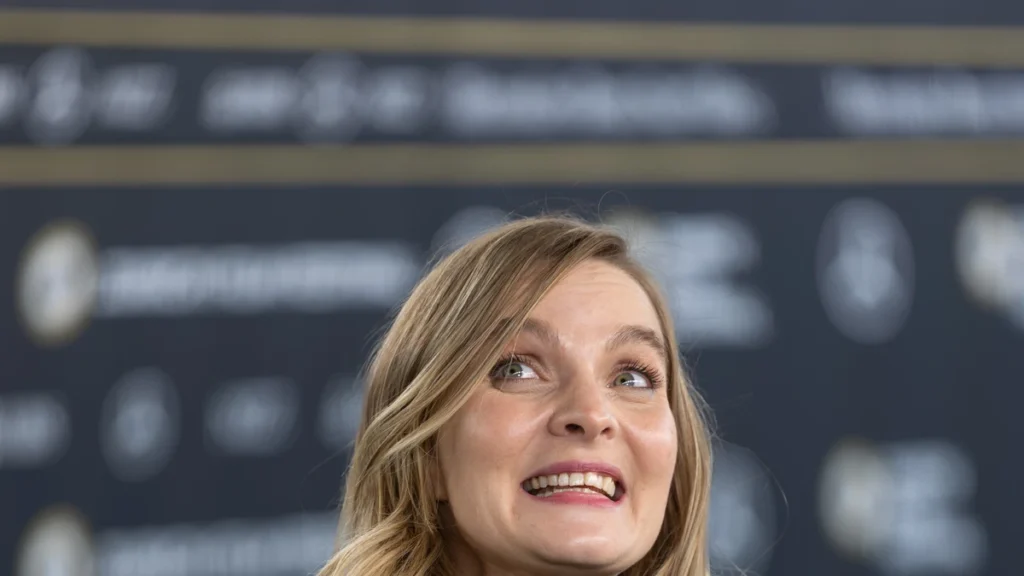
Hildur Gudnadottir at the Zurich Film Festival.
Hildur Gudnadottir at the Zurich Film Festival.
Hildur Gudnadottir scored The Bride, whose soundtrack arrived in February, and 28 Years Later: The Bone Temple in the same period.
She is nominated for film composer of the year at the 26th World Soundtrack Awards, which take place in Ghent on 10 October.
She Took Over The Bride
The Bride came to her after another composer had been attached and departed, which is a more common occurrence than the credits suggest.
Taking over a score mid-project is a specific kind of assignment. The film’s edit is usually further advanced, the director has already formed opinions from temporary music, and the timeline is shorter than it would have been.
It also means the incoming composer inherits a set of expectations they had no part in setting, which can be either useful direction or an obstacle.
That the resulting score has drawn a composer-of-the-year nomination suggests the circumstances did not constrain it.
Two Horror-Adjacent Films, Two Problems
The Bride and the 28 Years Later sequel both sit near horror, but they present entirely different scoring problems.
A gothic reimagining works on atmosphere, dread and a sense of the uncanny sustained across long stretches.
A post-apocalyptic infection film works on shock, propulsion and physical intensity, and the score has a much more percussive job.
Scoring both in one period means writing two opposed kinds of tension without either bleeding into the other.
The Cello Underneath Everything
Gudnadottir is a cellist, and the instrument runs through her scores in ways that are not always obvious.
The cello’s range sits close to the human voice, which is why it reads as expressive rather than decorative even when heavily processed.
Her scores frequently take that sound and extend it electronically until the source is unrecognisable, which produces textures that feel organic without being identifiable.
A Third Film in the Same Period
She also scored Hedda, which is a literary adaptation rather than a genre picture.
Three films in a year across gothic horror, post-apocalyptic action and a nineteenth-century drama is a wide spread by any standard.
Composers at this level are increasingly expected to work at that rate, which is one reason so many of them now run scoring teams rather than working alone.
The Ghent Category Is Strong
The film composer of the year category also includes Alexandre Desplat, Daniel Pemberton, Max Richter and Jonny Greenwood.
That is an unusually deep field, and it spans very different approaches to the job, from full orchestral writing to minimalist and electronic scoring.
A category that can hold all of those approaches at once is a fair reflection of how varied film scoring has become.
What the World Soundtrack Awards Are
The awards run alongside Film Fest Gent and are among the few dedicated specifically to film music rather than treating it as one category among many.
The ceremony is paired with a concert, which is a meaningful difference. Scores are performed rather than merely named.
For a field whose work is almost always heard underneath something else, an evening where the music is the event is not a small thing.
Composers Who Come From Performance
Gudnadottir came to film through performance and through experimental and improvised music rather than through a conservatory scoring programme.
That background is audible. Scores written by performers tend to prioritise sound and physical gesture over harmonic architecture.
It is also increasingly the norm, and the shift has changed what film music sounds like over the last fifteen years.
Horror Is Where Scoring Is Most Free
Horror and its neighbours give a composer more latitude than almost any other genre, because the audience accepts sounds there that would be rejected elsewhere.
Extended technique, noise, extreme processing and long passages with no discernible pitch are all standard, and all would be unacceptable in a comedy or a drama.
That is why so many of the most inventive scores of the last decade have come from genre films, and why composers with experimental backgrounds gravitate to them.
Sequels and What They Demand
Scoring the fourth film in a series carries an obligation the first does not, because an established sonic identity already exists.
Ignoring it disorients the audience. Reproducing it exactly makes the score redundant.
The workable position is usually to keep one or two recognisable elements and rebuild everything around them, which requires knowing which elements the audience actually remembers.
Icelandic Composers in Film
An unusual number of composers working in international film come from Iceland, which is a small country with a very small population.
The explanation is partly institutional. Iceland has strong music education, a dense and non-hierarchical scene, and a tradition of musicians moving freely between classical, pop and experimental work.
That mobility produces exactly the profile film scoring now wants: composers comfortable with an orchestra, a laptop and a broken instrument in equal measure.
Award Season Sequencing
The Ghent ceremony in October sits ahead of the main award season and functions partly as an early indicator.
It is decided by a different body from the Academy and rewards the year’s work as a whole rather than a single score, which is a more useful measure for a composer working across three films.
A composer-of-the-year nomination is therefore a comment on the volume and range of the output as much as on any individual piece of music.
Why Composers Get Replaced
Score replacement is one of the least discussed and most routine facts of film production, and the reasons are almost never about competence.
Schedules are the most common cause. A film that moves its release date, extends post-production or recuts substantially can run past a composer’s availability, and composers at this level are booked eighteen months ahead.
Creative divergence is the second. A director who has been cutting to temporary music for months can develop a fixed idea of what the film should sound like, and if the score being written is not that, the gap becomes irreconcilable late rather than early.
The third is simple change of hands. Producers, studios and directors all have opinions, and a score is one of the last elements to be locked, so it absorbs pressure from every unresolved argument above it.
Temp Music and the Problem It Creates
Editors cut with temporary music, usually taken from existing scores, because a sequence needs some kind of musical shape to be assessed at all.
The difficulty is that everybody involved watches the film hundreds of times with that music attached, and it becomes the version they know. A new score then has to overcome months of accumulated familiarity with somebody else’s work.
The usual outcome is temp love, where the director asks for something that sounds like the placeholder, which produces scores that are legally distinct imitations of other films.
A composer arriving late in the process faces this in its most acute form, and the good outcome is a score that answers what the temp was doing rather than what it sounded like.
What Is Actually Being Tested
Two things. Whether a score inherited mid-production can carry a film as coherently as one developed from the start.
And whether working across three tonally opposed films in a year sharpens a composer or dilutes what makes their work identifiable.
A gothic reimagining, a fourth infection film, a nineteenth-century drama, and a nomination that covers all three.
About The Author