Floating Points Mere Mortals Was Written for a Ballet Orchestra
7 min read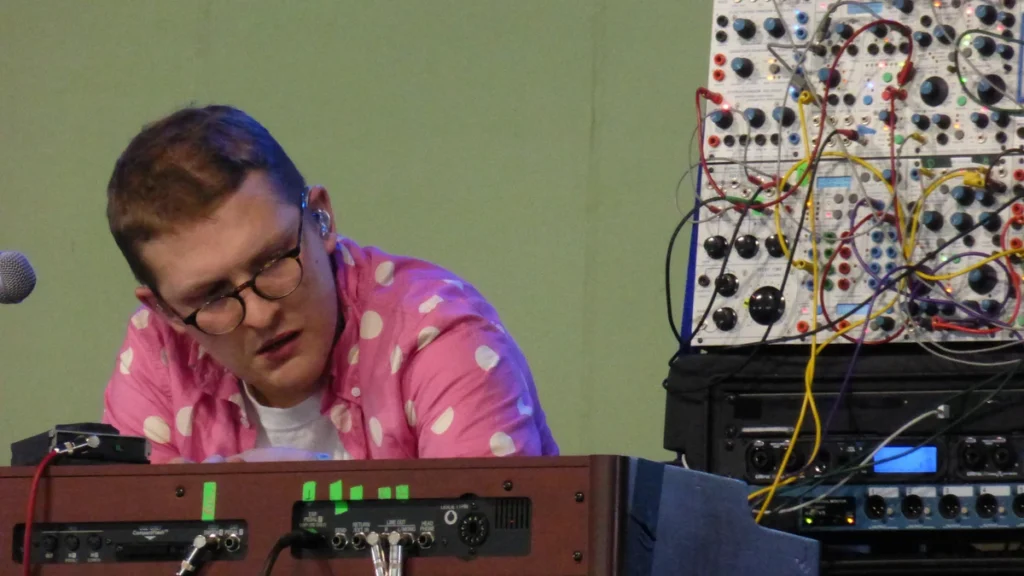
Sam Shepherd performing as Floating Points at Coachella.
Sam Shepherd performing as Floating Points at Coachella.
Floating Points Mere Mortals arrived on 28 August through Deutsche Grammophon, and its origin is the most unusual thing about it. The fourteen-track album began as a ballet score.
Sam Shepherd wrote it for the San Francisco Ballet, and the orchestra that premiered it is the orchestra that recorded it.
The Score Existed Before the Album
The work premiered in January 2024, with Shepherd playing synthesisers alongside the San Francisco Ballet Orchestra in the pit.
That sequence matters. Most orchestral records by electronic producers are studio constructions that later get performed. This one was staged first and recorded afterwards.
Music written for dance carries constraints that concert music does not. It has to hold a tempo a body can move to, and it has to change when the choreography changes, which shapes the writing at a structural level.
Recording it after two years of performance also means the players know it. An orchestra reading a new score for the first time and an orchestra that has danced a season with it produce different takes.
Pandora, Rewritten as an AI Story
The narrative reworks the Greek myth of Pandora as a contemporary story about artificial intelligence, curiosity and change.
The parallel is not subtle and does not need to be. Pandora is a made being who opens something she was told to leave closed, and the consequences cannot be recalled.
Applied to machine intelligence, that maps almost too neatly, which is presumably the point. The myth already contains the argument being had now about creation, curiosity and irreversibility.
What keeps it from being merely topical is that the myth is older than the anxiety. The story is not being borrowed to comment on the moment; the moment is being placed inside a story that predates it by millennia.
Deutsche Grammophon Is a Deliberate Choice
Releasing through Deutsche Grammophon rather than an electronic label positions the record inside classical music rather than adjacent to it.
DG is the oldest surviving classical label and its yellow cartouche carries a specific institutional weight. Records released through it are catalogued and reviewed as classical releases.
For a producer who came out of London dance music, that is a substantive reclassification rather than a marketing decision, and it changes which critics write about the album.
Falling To Earth Ran Thirteen Minutes
The first single, released in May, was a thirteen-minute excerpt combining orchestral instrumentation with live synths and electronic production.
Releasing a thirteen-minute lead single is a refusal of the ordinary campaign logic, which wants something short enough to be added to playlists.
It signals that the album is meant to be heard as a continuous work, and that the label is not going to pretend otherwise for the sake of a streaming metric.
Her Gift Is a Duet for Two Instruments
The second single, released in June, is described as a duet written for harp and Therevox ET 4.3.
The Therevox is a modern electronic instrument descended from the Ondes Martenot, the early twentieth-century keyboard best known from Messiaen’s orchestral writing.
Pairing it with a harp is a precise choice. Both instruments have a distinctive attack and a long decay, and both sit awkwardly in a conventional orchestral texture, which makes them natural partners.
Shepherd Has Done This Before
This is not Shepherd’s first orchestral work. He has previously recorded with a full symphony orchestra on a collaborative album, and orchestral writing has been part of his practice for years.
His records have consistently moved between club-oriented electronic music and long-form composition, sometimes on the same album.
That history is why a ballet commission is a logical development rather than a swerve. The audience for his work has been prepared for it across several records.
Fourteen Tracks From a Continuous Score
A ballet score is continuous music. Dividing it into fourteen tracks is an editorial decision made for the recording rather than something inherent to the work.
Track divisions in this context are closer to movement markings than to songs, and they exist so the record can be navigated.
The thirteen-minute single suggests the divisions are uneven, which is what you would expect from music following choreography rather than a verse structure.
Why Ballet Commissions Are Rising
Ballet companies have been commissioning scores from outside classical composition with increasing frequency, and the reason is audience rather than aesthetics.
A company that commissions a well-known electronic producer brings in people who would not otherwise attend a ballet, and does so without altering the art form.
For the composer, the commission provides an orchestra, a rehearsal period and a premiere, which are resources almost impossible to assemble independently.
The Scientist Background Is Not Incidental
Shepherd holds a doctorate in neuroscience, a detail that gets mentioned in nearly every profile and is usually treated as trivia.
It is more relevant than that. His music consistently works with slow parametric change, where a texture is transformed gradually across a long duration rather than through abrupt cuts.
That is a way of thinking about a system evolving over time, and it is recognisably the same habit of mind whether applied to a synthesiser patch or to an experiment.
Where the Album Sits Commercially
An orchestral ballet score on a classical label is not a streaming proposition, and nobody involved is pretending it is.
The economics run on physical sales, classical chart placement, licensing and the continued life of the ballet in repertory.
That last part is the durable asset. A ballet that enters a company’s repertoire gets performed for decades, which is a longer revenue tail than any album has.
The August Release Window
Landing on 28 August put the record on one of the busiest release Fridays of the year, though almost none of the competition is in the same category.
Classical releases operate on a separate calendar and a separate review economy, so the crowding in rock and pop is largely irrelevant.
What the date does provide is a clear run into the autumn concert season, when the classical press is at its most active.
Two Audiences, One Record
The album has to work for people who arrived through Shepherd’s dance records and for people who buy Deutsche Grammophon releases, and those groups want different things.
The first group will listen for the electronics and for the rhythmic writing. The second will listen to the orchestration and the handling of the ensemble.
Records that try to satisfy both usually fail at one. A score that has already survived a staged production has better odds than most, because the choreography enforced a discipline no studio deadline would have.
What an Orchestra Costs and Who Pays for It
The single largest obstacle to any producer wanting to write orchestral music is that orchestras are expensive and cannot be hired speculatively. A full ensemble for a recording session runs into five figures per day before a hall, an engineer or a conductor is booked.
That is why most electronic records described as orchestral are in fact small string sections multiplied in the mix, or sample libraries handled well. There is nothing dishonest about either, but neither produces the sound of an ensemble that plays together every week.
A ballet commission removes the problem entirely. The company already employs the orchestra, the rehearsal time is budgeted, and the premiere is scheduled regardless of whether a record ever exists.
Understood that way, the commission is not just an artistic opportunity. It is the only realistic route by which a producer gets to write for a standing orchestra and hear the result played properly.
Electronics Inside an Orchestral Texture
Placing synthesisers inside an orchestra is harder than it sounds, and the difficulty is acoustic rather than conceptual. An orchestra produces sound from many separate points in a room, while a synthesiser arrives through a PA from two.
The usual failure is that the electronics either sit on top of the ensemble like a separate record or disappear into it entirely. Getting them to occupy the same space requires writing that leaves room in the orchestration rather than mixing decisions made afterwards.
Shepherd playing the synths himself in the pit during the premiere is the relevant detail. A composer who performs their own electronic part inside the ensemble learns where the gaps are in a way no studio session teaches.
The Therevox duet points the same direction: an electronic instrument chosen because it behaves like an acoustic one rather than because it sounds futuristic.
What Is Actually Being Tested
Two things. Whether music written to accompany movement holds up as a listening record without the dance, because a score can be excellent in the theatre and inert on speakers.
And whether a producer can move into a classical institution without the work becoming a novelty item on either side.
Fourteen tracks, a ballet orchestra, a myth about opening something that cannot be closed, and a producer with a doctorate writing about artificial intelligence.
About The Author