Bill Frisell In My Dreams Has Nine Originals and Three Covers
5 min read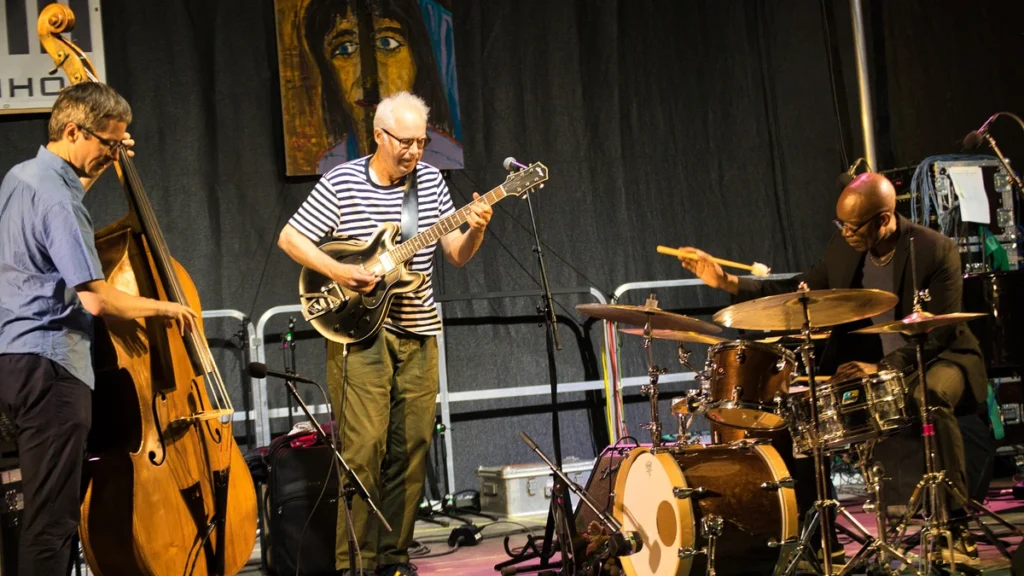
Bill Frisell performing with his trio.
Bill Frisell performing with his trio.
Twelve tracks, nine of them written by the bandleader, three of them covers. Bill Frisell In My Dreams arrived on Blue Note on 27 February, and the split between original and borrowed material is the clearest statement the record makes about what it is.
A jazz guitarist approaching his mid-seventies could reasonably have made a standards album. This is mostly new writing, played by a band assembled from people he has worked with for the better part of forty years.
The Dream the Album Is Named After
The title is literal. Blue Note’s own account describes a dream Frisell had more than three decades ago and can still recall exactly.
In it he enters a darkened building, climbs a stairwell and finds a library of leather-bound volumes. Hooded, monk-like figures sit around a table. They seem forbidding, then turn warm. “We want to show you what things really are,” they say. “First, we’d like to show you what colours really look like.”
Frisell’s account of what followed is specific: they opened a small box, took out blocks, pointed at one and said this is what red looks like. Then, knowing he was a musician, they let him hear what real music sounds like. He describes something like a tube entering his forehead, and hearing Nino Rota, Thelonious Monk, Sonny Rollins, Charles Ives, Jimi Hendrix, Hank Williams, Andrés Segovia and Robert Johnson at once, every part crystal clear.
He has been chasing that clarity since. The album is presented as the closest he has come.
A Six-Piece With Four Decades of History
The personnel are the argument for why this record sounds settled rather than experimental. JazzTrail lists Frisell on acoustic and electric guitars, Jenny Scheinman and Eyvind Kang on violins, Hank Roberts on cello, Thomas Morgan on bass and Rudy Royston on drums.
Those relationships are long. Something Else! notes that at least one of the string players appears on Frisell records going back to Lookout For Hope in 1987. Royston’s association developed in the late 1990s and he has been a steady presence since 2010. Morgan joined the core group around 2016.
That is not a band assembled for a session. It is a group with a shared vocabulary, which is why a record with a string trio and a rhythm section does not sound like a guitarist plus accompaniment.
Strings Used as a Section, Not as Sweetening
The string trio is the element that separates this from a conventional jazz guitar record. Used badly, strings on a jazz album are decoration laid over a finished arrangement.
Here they carry material. The programme opens with a violin duet, Trapped in the Sky, before the band enters. That sequencing decision tells the listener immediately that the strings are not an overdub.
Something Else! reads the record as the fullest embodiment of the Americana, chamber and jazz blend Frisell developed in the late 1980s and early 1990s, a style he has returned to repeatedly since. On that reading In My Dreams is less a new direction than a definitive statement of an existing one.
Why This Line-Up Is Unusual for a Jazz Record
A string trio alongside a jazz rhythm section is a configuration most guitarists never attempt, because it creates a balance problem. Strings sustain, an electric guitar sustains, and a drummer has to play around both without flattening either.
The solution here is longevity. Musicians who have played together for decades resolve that balance by instinct rather than by arrangement, which is why the record can carry six players without sounding crowded.
Frisell’s own doubling on acoustic and electric guitar adds a further variable. The two instruments occupy different space against strings, and switching between them across a programme gives the arranger a lever that a single-instrument player does not have.
Recorded Live
The album was recorded live, with studio enhancements added afterwards rather than the record being constructed in pieces.
For a six-piece playing this kind of material, that choice matters more than it would for a smaller group. String parts written against a rhythm section behave differently when everyone is reacting in the room, and the interplay cannot be reproduced by tracking parts separately.
It also explains the record’s pacing. A live take commits the band to tempos and dynamics as played, which produces the unhurried quality reviewers have consistently described.
Reaching Back Into the Catalogue
The second track, When We Go, is drawn from Rambler, Frisell’s debut album from 1985. Revisiting a piece from a first record four decades later is a deliberate framing device.
JazzTrail describes the treatment as relatively straightforward: Frisell introduces it with pointillistic gestures, looping textures and smooth phrasing before an in-the-pocket four-four pulse emerges and the jazz and folk elements intertwine.
That is characteristic of how the whole record handles its material. Nothing is deconstructed for its own sake, and the arrangements resolve rather than dissolve.
Nine and Three, and Why the Ratio Matters
The nine-to-three split is the number worth holding on to. A covers-heavy jazz record is a curation exercise; the interest lies in the choices and the readings.
A record that is three-quarters original writing is making a different claim. It says the compositional voice is the point, and the covers are there to place that voice in a lineage rather than to carry the album.
Given the dream that supplies the title, with its list of Monk, Rollins, Ives, Hendrix, Hank Williams, Segovia and Robert Johnson, a record that mixes original writing with a small number of chosen covers is close to a literal enactment of the idea.
The names in that list are worth noting for what they are not. There is no attempt at stylistic coherence between a bebop saxophonist, an American modernist composer, a rock guitarist, a country singer and a classical guitarist. The dream’s claim was that all of it could be heard at once, with every part distinct.
That is a reasonable description of what Frisell’s music has been doing for forty years, which is why the anecdote functions as an artistic statement rather than a piece of promotional colour.
Where It Sits Commercially
Jazz records of this kind are not chart propositions and are not built to be. They are catalogue: they sell steadily to a defined audience, accumulate through recommendation, and stay in print.
The economics resemble what we looked at when examining how vinyl’s actual market share compares with the attention it receives. For a jazz release on a heritage label, physical sales to a committed audience matter far more than streaming volume, and the format’s small overall share is irrelevant to whether this particular record works.
A Blue Note release also carries distribution and shelf presence that an independent jazz album does not, which is the practical reason a record like this reaches listeners who would otherwise never encounter it.
What the Record Is Actually For
Twelve tracks, six players, a band with four decades of shared history, and a thirty-year-old dream as the stated brief. There is no reinvention here and none is attempted.
The interest is in whether a musician can get closer to a sound he has been describing for most of his career. On the evidence of the reviews, this is the attempt that gets nearest.
About The Author