Rhiannon Giddens Reunited With Justin Robinson for a Duo Album
6 min read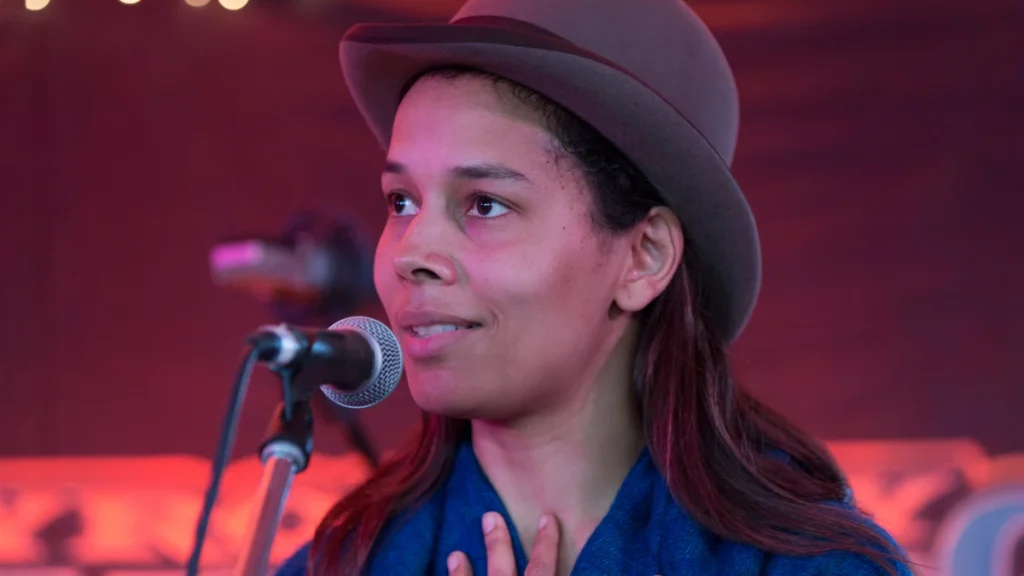
Rhiannon Giddens performing live.
Rhiannon Giddens performing live.
Rhiannon Giddens reunited with Justin Robinson for What Did the Blackbird Say to the Crow, an album of eighteen North Carolina fiddle and banjo tunes released through Nonesuch Records.
The two played together in the Carolina Chocolate Drops, and the record is nominated for Best Folk Album at the Grammys.
Two Instruments and Nothing Else
Giddens plays banjo, Robinson plays fiddle, and that is the entire instrumentation across eighteen tracks.
Fiddle-and-banjo duo music is one of the oldest configurations in American string-band tradition and predates the bluegrass ensemble by generations.
Recording it as a duo in 2025 is not a stylistic exercise. It is the format the material was written for, and playing it any other way changes what the tunes are.
Eighteen tracks in forty-three minutes also tells you these are tunes rather than songs. The average is under two and a half minutes, which is the traditional length.
Recorded Inside Three Houses
The sessions took place over three days in May 2024, on location in three North Carolina buildings rather than in a studio.
They recorded at Etta Baker’s house in Morganton, at the Mill Prong House in Red Springs, and at Joe Thompson’s house in Mebane.
Recording in a domestic space rather than a treated room produces a different sound: more reflection, more floor, more of the building audible around the instruments.
For music that was originally played in exactly those rooms, that is not a compromise. It is closer to accurate.
Joe Thompson Taught Them Both
Joe Thompson was a Piedmont fiddler and one of the last direct links to the Black string-band tradition, and he mentored the Carolina Chocolate Drops until his death in 2012.
Many of the tunes on the record were learned directly from him, which makes the album a document of transmission rather than an act of research.
Recording in his house is the clearest possible statement of that. The songs came from that room and were returned to it.
The Black String Band Tradition
The banjo is an instrument of African origin, and the string-band music that became old-time and then bluegrass was substantially Black in its formation.
That history was systematically obscured through the twentieth century as the commercial category of hillbilly and later country music was constructed along racial lines.
Giddens has spent her career on this, in performance, in writing and in institutional work, and this record is the plainest version of the argument: the music, played as it was played, by people who learned it from someone who learned it.
A Tune From Etta Baker
One track was learned from Etta Baker, the Piedmont blues guitarist who recorded into her nineties and is one of the defining figures of that regional style.
Recording at her house as well as Thompson’s turns the album into a small geography, with each location standing for a lineage.
That is a considered way to build a record and a difficult one to execute, because it requires the music to justify the framing rather than the other way round.
The Carolina Chocolate Drops Reunion
Giddens and Robinson were both founding members of the Carolina Chocolate Drops, the band that brought Black string-band music back into general circulation.
The group won a Grammy and reached audiences far outside traditional music before its members went in different directions.
A duo record between two of them, working the same material, is closer to a continuation than a reunion. The band was always a vehicle for this repertoire.
Nonesuch and Records That Do Not Sell Fast
Nonesuch has released Giddens’s work for years and is one of the few labels with a genuine institutional commitment to music that does not perform quickly.
Its catalogue spans contemporary classical, jazz, world traditions and American roots music, all of which operate on decades rather than release weeks.
An eighteen-track fiddle-and-banjo album is exactly the kind of record that infrastructure exists to support, and it would be nearly unreleasable elsewhere.
Giddens’s Wider Position
Giddens is one of the few musicians working across performance, composition, scholarship and public institutions at the same time.
She has written opera, presented radio, held artistic directorships and recorded across several traditions, and the work is consistently organised around the same set of questions.
That breadth is why a record this specialised gets attention. An audience that arrived through her larger-scale work follows her to a duo album of old-time tunes.
What the Grammy Nomination Means Here
The Best Folk Album category is one of the few places where a record like this can compete on equal terms with far more commercial releases.
A nomination brings the album to listeners who would never encounter a Piedmont fiddle-and-banjo record otherwise, which is the practical value of genre categories.
The field this year is unusually strong, which makes the nomination itself the meaningful part rather than the outcome.
Why On-Location Recording Is Hard
Recording outside a studio sounds romantic and is technically difficult. There is no isolation, no controlled acoustic and no ability to fix a take by rebuilding it afterwards.
Every sound in the building ends up on the recording, and the performances have to be right in the room rather than assembled later.
For two players on acoustic instruments that is achievable, and it is why this kind of session works for a duo and would not for a full band.
Tunes Rather Than Songs
Most of this repertoire is instrumental dance music rather than song material, which changes how an album of it functions.
There is no narrative arc, no lyrical development and no obvious single. The interest is entirely in the playing and in the variation between tunes.
That is a demanding proposition for a general listener and a rewarding one for anyone who follows the form, which is roughly the audience the record is aimed at.
The Producers
The album was produced by Giddens with Joseph DeJarnette, who works under the name joebass and specialises in exactly this kind of recording.
Producing traditional music is largely a question of restraint. The job is to capture the performance and stay out of it, which is harder than it sounds.
Having the artist co-produce is standard in this field, because the person playing usually knows better than anyone what the recording should sound like.
Why the Banjo’s Origin Keeps Getting Restated
The banjo arrived in North America with enslaved West Africans, developed from gourd-bodied instruments with a skin head and a drone string, and was for its first century in the Americas an overwhelmingly Black instrument.
What changed it was minstrelsy. White performers adopted the instrument as part of a racist entertainment form, and by the early twentieth century the banjo had been so thoroughly recoded that its origin became genuinely unfamiliar to most listeners.
The commercial recording industry then completed the separation. Record companies in the 1920s sorted the same regional repertoire into race records and hillbilly records along the colour line, and the two categories were marketed to different audiences as though they were different musics.
That is why a record like this keeps having to make the point. The history is not obscure to anyone who looks, but the shape of the industry has spent a century arranging things so that nobody has to.
What a Mentor Actually Transmits
Learning tunes from a living player rather than from recordings changes what gets passed on, and the difference is larger than it appears.
A recording gives you the notes. A player in a room gives you bow pressure, where the beat sits, which phrases get pushed and which get held back, and the hundred small decisions that separate a tune played correctly from a tune played properly.
Those things are close to impossible to notate and only partly audible on a record. They travel by sitting next to somebody for years, which is what both musicians did with Joe Thompson.
An album made from that material is therefore a document of a specific chain of transmission rather than a general survey of a regional style, and it is why the location of the sessions is not merely sentimental.
What Is Actually Being Tested
Two things. Whether eighteen short instrumental tunes can hold an album-length listen for anyone outside the tradition.
And whether the location recording is audible as anything more than a good story. If the rooms are not present in the sound, the concept is decoration.
A banjo, a fiddle, three houses in North Carolina, and a repertoire handed down by a man who died in 2012.
About The Author