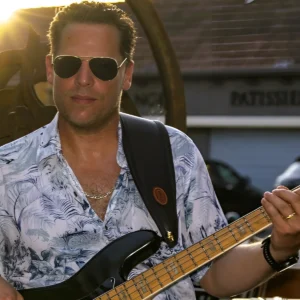
Myles Smith’s Debut Album Already Contained His Biggest Hits
5 min read
By the time Myles Smith released his debut album in June, most of its best-known songs were years old. “Stargazing” and “Nice to Meet You” came out in 2024. “Gold” followed in 2025. All three are on it.
My Mess, My Heart, My Life. arrived on 19 June 2026 through It’s Okay to Feel and Sony UK, running forty-five minutes and fifty-four seconds.
A Debut That Is Partly a Compilation
Smith’s two EP titles tell the story on their own — A Minute… and then A Minute, a Moment…, each an extension of the last. The album continues that sequence rather than breaking from it.
This is now a standard shape and it is worth being precise about what it does. Smith built an audience through EPs — A Minute… in 2024 and A Minute, a Moment… in 2025 — and the songs that made his name lived there first.
Putting them on the album guarantees the record contains hits on day one. It also means the debut is not really a debut in the traditional sense: it is a consolidation, gathering scattered successes into one object with new material around them.
The cost is that the album cannot introduce him, because he has already been introduced. What is left for it to do is prove there is more, and that is a much harder job than the one a debut usually has.
It is a genuinely new problem. For most of recorded-music history a debut album WAS the introduction, because there was no other way to be heard at scale. Streaming inverted that: an artist can now be widely known for individual songs long before anyone commits to a long-form statement, and the album becomes a retrospective of a career that has already happened.
Five Singles Before It, Too
The new material was heavily previewed as well. “Stay (If You Wanna Dance)” appeared in September 2025, “Drive Safe” in February 2026, “My Mess” in April, “Hold Me in the Dark” in May and “Heaven” on 17 June — two days before the album.
The final single landing two days before the album is the detail that gives the strategy away. At that distance a single cannot build anticipation; it can only make sure the record enters the week with fresh activity attached to it.
Five singles plus three older songs means a substantial share of the record was public before release day. For a listener following him, the album was less a reveal than a filing system.
The release also moved. Announced on 20 March for 12 June, it was pushed back a week on 30 April, which is a small thing but not nothing on a debut with an arena tour behind it.
The Guardian Was Not Persuaded
Reviews of records like this tend to split along a predictable line: writers assessing originality reach one verdict, and the streaming numbers reach another. Both are measuring something real, and neither is a rebuttal of the other.
The most pointed response came from Alexis Petridis at The Guardian, who gave it two out of five and located the problem in Smith’s origins as a covers artist.
Petridis wrote of “how indebted Smith still is to the artists he started out covering”, naming Mumford & Sons, Coldplay and Ed Sheeran, and called the album “faceless and formulaic”. His conclusion was blunt: “it’s hard to see what Smith is actually bringing to the party, beyond an amalgamation of his favourite artists”.
It is a harsh notice and it deserves to be reported as one rather than softened. It is also a single review, and one whose central charge — derivativeness — is the standard criticism levelled at almost every commercially successful British singer-songwriter of the last fifteen years.
Petridis is also describing a real lineage rather than inventing one. Smith came up posting covers, and the three acts named are the dominant reference points for exactly that route into British pop — the question is whether an artist who learned by imitation ever fully stops.
The Counter-Evidence Is the Audience
Set against that, the songs have plainly connected. “Stargazing” and “Nice to Meet You” are the records that made him, and they did so without a label campaign built around an album, because there was no album.
An English and Irish arena tour follows in November. Arenas are not booked on critical consensus; they are booked on ticket demand, and that demand accumulated over two years of EPs rather than in the weeks after a release.
Both things can be true. A record can be derivative and still be the thing a large number of people wanted, and a reviewer’s job is not to adjudicate the second point.
There is also a straightforward commercial logic that reviewers rarely have to weigh. A debut carrying three known songs converts far better than one that does not, because a listener arriving from a playlist finds something familiar immediately. Whatever it costs artistically, it is not an irrational choice.
Seven Producers on One Record
The credits do offer some support for the faceless charge, though not conclusively. The album lists Ammo, Will Bloomfield, Peter Fenn, Jesse Fink, Oscar Görres, Gabe Simon and Smith himself as producers.
Seven producers on a debut is a lot, and it is the standard construction method for a major-label pop record: assemble the best available rooms, keep what works. It optimises for a high floor rather than a distinctive ceiling.
An artist trying to answer a charge of having no identity is not helped by a process designed to smooth identity out. Whether that is what happened here is a judgment the record has to settle, but the shape of the credits is at least consistent with the criticism.
In fairness, Smith is credited among the producers himself, which is not nothing — it is at least a claim on the record rather than a passive acceptance of what the rooms produced.
What a Second Album Would Have to Do
The structural problem is now visible. Having spent his back catalogue on the debut, Smith arrives at album two with nothing held in reserve and a critical framing to argue with.
That is the point at which artists in this position usually either narrow — fewer collaborators, a clearer voice — or widen further into the machinery. Our piece on why playlist placement is distribution rather than marketing covers how songs like his reach an audience without an album behind them.
Delaying the record by a week, late in the campaign, hints at how carefully the release was being managed. Debuts by artists with arena tours booked tend to be handled as logistics as much as art, and that pressure is part of the environment the album was finished in.
The audience is already there. What the next record has to establish is what it is for.
On the arena dates in November, the three songs everyone came for will be the oldest ones in the set. That is the position the album has left him in, and the next one is the answer to it.
My Mess, My Heart, My Life. is out now on It’s Okay to Feel and Sony UK.
About The Author