Lady A Booked Eight Christmas Shows Ending at the Ryman
6 min read
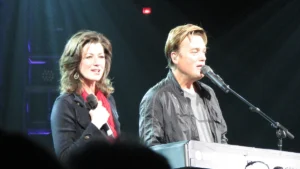
Lady A, then performing as Lady Antebellum, at Daytona in 2017.
Lady A, then performing as Lady Antebellum, at Daytona in 2017.
Lady A have booked eight Christmas shows for December, opening on 10 December at Northfield Park Racino in Ohio and closing on 21 December with two nights at the Ryman Auditorium in Nashville.
It is their second consecutive December run, following a first attempt in 2025 that went well enough to repeat.
Eight Shows in Twelve Days
An eight-date run compressed into under two weeks is a specific kind of touring, and it is nothing like a conventional album cycle.
There is no radio campaign to support, no new record to sell and no market to build. The shows exist because the calendar creates demand for them.
That compression is also what makes them viable. Eight dates can be routed tightly, the production travels once, and the whole run is over before Christmas Eve.
For a band whose members have families and separate projects, a twelve-day commitment is a very different proposition from a six-month tour.
Two Nights at the Ryman
Closing with two nights at the Ryman Auditorium is the detail that shapes the run.
The Ryman is a former church, seats around two thousand, and is treated in Nashville as the most significant room in the city despite being far from the largest.
Its acoustics are exceptional for unamplified and lightly amplified music, and its association with country’s history gives a booking there a weight that arena dates do not carry.
Why a Church Is the Right Room
The Ryman was built as a tabernacle, and the pews are still pews.
For a Christmas show that is not incidental. The material is substantially sacred or sacred-adjacent, and a room built for congregational singing does something an arena cannot.
Christmas concerts in general work better in smaller and older buildings, which is why so many of them avoid the venues the same artists play in summer.
What Dave Haywood Said
Haywood described the 2025 run in straightforward terms. “Last year’s Christmas shows truly filled our hearts with the magic of the season,” he said. “We had so much fun that we couldn’t imagine not doing it again.”
That is a modest justification and probably an accurate one.
Christmas shows are frequently more enjoyable for performers than regular touring, because the audience arrives in a different mood and the setlist has no promotional obligation attached.
The Albums Behind the Name
The tour takes its name from the band’s holiday catalogue, which began with a Christmas extended play in 2010 and became a full album in 2012.
Building a December touring franchise on a fourteen-year-old record is a good illustration of how holiday catalogues work.
A Christmas album that finds any audience keeps circulating annually, and eventually accumulates enough familiarity to support a live event.
The Second Year Is the Test
A first Christmas run is an experiment. A second one is a decision to build something recurring.
Annual December residencies and short runs have become a substantial business for artists at this level, and several acts now derive a meaningful share of their touring income from them.
What makes it durable is that the audience treats it as an occasion rather than a concert, which produces repeat attendance in a way ordinary touring does not.
Country Music and Christmas
Country has an unusually strong relationship with holiday music, and the reasons are structural.
The genre’s audience skews toward family listening, its radio format programmes seasonal music heavily, and its performers are generally comfortable with the sacred material that other genres avoid.
The result is that a country Christmas album has a clearer route to an audience than a pop one, and a country Christmas tour has a clearer route to a ticket buyer.
Ohio to Nashville by Way of New York
The routing includes New York City and Greensboro, North Carolina, alongside the Ohio opener and the Nashville close.
That is a compact eastern and midwestern circuit rather than a national tour, which is the correct shape for eight dates in twelve days.
Finishing at home in Nashville is also the obvious sequencing, since it lets the band end the run without another journey.
The Band’s Position Now
Lady A have been recording since the late 2000s and had one of the largest crossover country singles of that era.
They changed their name from Lady Antebellum in 2020, and the group has continued recording and touring since.
Acts at that stage of a career typically move from radio-driven album cycles to catalogue-driven touring, and a December run is one of the clearest expressions of that shift.
Why December Touring Works Financially
The economics of a holiday run are favourable in a way ordinary touring is not.
Demand is concentrated, the audience is buying an experience rather than a performance of new material, and ticket prices hold up because the alternative entertainment options that month are limited.
Costs are also lower on a short run. There is no lengthy production build, no international freight and no extended crew commitment.
Setlists With No Promotional Job
A Christmas show is one of the few contexts where an artist is not expected to play new material.
The audience wants the standards and the band’s own holiday songs, in roughly that order, with a handful of hits to justify the ticket.
That removes the usual tension between what a band wants to play and what the room came for, which is a large part of why performers describe these shows as enjoyable.
The Rise of the December Residency
Short seasonal runs have quietly become one of the more reliable revenue lines in live music, and the number of artists building them has grown steadily.
The model works because it inverts the usual relationship between touring and recording. A conventional tour exists to support an album and is scheduled around a release; a December run exists on its own and requires nothing new to justify it.
It also solves a chronic problem in the live calendar. December is traditionally weak for touring, because arenas are booked with sports and family commitments compete for the audience’s time. A show framed as part of the season rather than as competition with it converts that weakness into an advantage.
For a band with a mid-sized theatre audience and a fourteen-year-old holiday record, it may be the single most efficient use of two weeks available anywhere in the year.
What a Holiday Setlist Has to Solve
Building a Christmas show is a harder programming problem than it appears, because the audience arrives with two incompatible expectations.
They want the seasonal material, which is the reason they bought a December ticket rather than a summer one. They also want the songs that made them fans, which have nothing to do with Christmas and sit in a different emotional register entirely.
A show that leans too far toward the holiday repertoire risks feeling like a themed event with a band attached. One that leans too far the other way is an ordinary concert with tinsel on the lighting rig, and the audience notices immediately.
The workable structure most acts settle on is a two-part evening: the catalogue first, the seasonal material second, and the encore somewhere between the two. It is not sophisticated, but it is the arrangement that sends people home satisfied.
What Is Actually Being Tested
Two things. Whether a second consecutive December run establishes an annual fixture, which is the point at which the economics become genuinely attractive.
And whether a holiday catalogue built over a decade and a half can sustain eight nights, or whether the material runs short before the run does.
Eight shows, twelve days, a former tabernacle in Nashville, and a name borrowed from an album released fourteen years ago.
About The Author