Brandon Flowers Thrasher Lands 20 Years After Sam’s Town
5 min read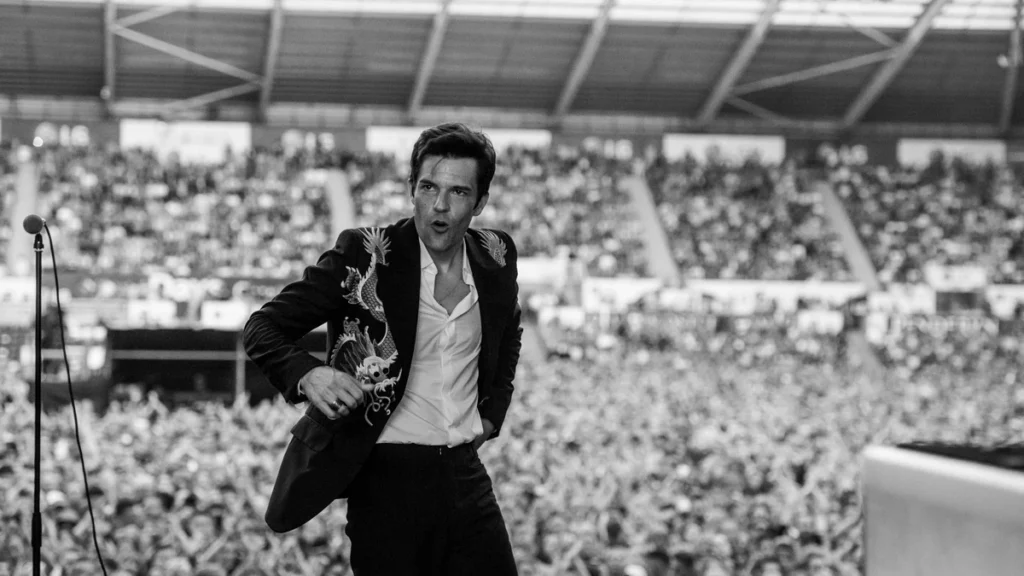
Brandon Flowers performing in 2018.
Brandon Flowers performing in 2018.
Twenty years, three solo albums, one decade-long gap. Brandon Flowers Thrasher was released on 21 August, and the date is the detail the record itself draws attention to.
It arrives exactly two decades after Sam’s Town, the Killers album that first pushed the band towards American roots music and was widely misread at the time.
Coincidence or Design
The album opens with a line that reads as a comment on its own timing. “Some may call it a coincidence / But I prefer design,” Flowers sings on Does It Ever Cross Your Mind?, as KXT noted in its review.
Asked directly whether the Nashville turn was coincidence or design, Flowers was non-committal. “Yeah, I don’t know,” he said, before describing seeds and breadcrumbs of country music and its storytelling running through his earlier work.
That is a more honest answer than a tidy narrative would have been. Sam’s Town was the record that got the Americana instincts wrong in the ears of critics at the time and has since been reappraised; a country album twenty years later is either a vindication or a coincidence, and he is declining to claim the first.
Recorded Where the Sound Came From
The location is not incidental. Rock Cellar Magazine reports the album was recorded at RCA Studio A in Nashville, with further work at June Audio in Provo, Utah.
Studio A is one of the rooms where the Nashville sound was built, and recording an outsider’s country record there is a statement about intent. It is the difference between adopting a genre and going to where it is made.
Provo matters for a different reason. Flowers’ songwriting has repeatedly returned to Utah and to small-town life, and splitting the sessions between Nashville and his own region keeps the record anchored to its subject.
The Players Are the Credential
The session personnel do more to establish the record’s seriousness than any press statement could. Rock Cellar lists David Rawlings on guitar, the long-time Gillian Welch collaborator; Bruce Bouton, a pedal steel pioneer; and Charlie McCoy, the harmonica player whose work appears on the four albums Bob Dylan recorded in Nashville.
Hiring McCoy in particular is a specific gesture. He is the direct link to the moment when a rock songwriter last went to Nashville and came back with a different kind of record.
Those are not names booked for marketing value. Most listeners will not recognise them, which is precisely what indicates the choice was made for the playing.
What the Songs Are About
KXT describes the album’s unrelenting focus on lives in the margins, which places it alongside the Killers’ 2021 record Pressure Machine rather than alongside their arena material.
That continuity matters more than the genre change. Pressure Machine dealt with Flowers’ childhood in Nephi, Utah, and a country record about people at the edges is a natural extension of that project rather than a departure from it.
The instrumentation is what changes. KXT notes that hearing pedal steel and fiddle behind a voice normally set against synthesisers and roaring electric guitars is faintly disorienting, which is a fair description of what the record asks of a Killers listener.
Three Singles Ahead of Release
Plans, Paradise and Tiger’s Blood went out before the album. Plans arrived in two versions, a studio recording and a live performance filmed at RCA Studio A itself.
Filming the live version in the room where the album was made is a neat piece of campaign logic. It documents the players and the space in a single asset, which is more persuasive than any description of the sessions.
A Decade Between Solo Records
Ten years between solo albums is a long gap even for a musician with a band to occupy him. The Desired Effect, released in 2015, is described by KXT as underrated, which is roughly the fate Sam’s Town suffered before its reappraisal.
A pattern is visible in that. Flowers’ work outside the Killers’ biggest singles has repeatedly been judged harshly on arrival and better later, which is a reason to be cautious about early verdicts on this one.
Why Rock Singers Struggle With Country
The difficulty is not instrumentation, which any competent producer can supply. It is that country holds writers to a stricter standard of specificity than rock does.
Rock lyrics can work on mood and image. Country writing is judged on whether the detail is true to the life it describes, and an audience raised on the form notices immediately when the specifics have been assembled rather than lived.
That is the actual test Thrasher faces, and it is why the Utah material matters more than the Nashville studio time. Flowers writing about the town he grew up in is on solid ground; Flowers writing generically about the road would not be.
Two Studios, Two Functions
Splitting sessions between Nashville and Provo divides the record’s two claims. Studio A supplies the sound and the players; June Audio supplies proximity to the subject.
Records made entirely on location in a genre capital often end up sounding like the place rather than the artist, because the local session culture is strong enough to absorb a visiting writer. Keeping part of the work at home is a hedge against that.
Whether the balance holds is the question the reviews are circling, and it is a more interesting one than whether a rock singer is allowed to make a country album.
The Reception Has Been Mixed
Coverage has not been uniformly positive. Rolling Stone’s review argued that the country turn leaves him somewhat lost, which is the predictable criticism of a rock songwriter working in an idiom with strict conventions.
The counter-argument is in the personnel. A record made with McCoy, Rawlings and Bouton is not an outsider guessing at the form, and the question is whether Flowers’ writing sits comfortably inside arrangements built by people who have made hundreds of these records.
Either way the album is being taken seriously as a country record rather than dismissed as a rock star’s detour, which is itself a result.
Where It Fits in the Country Market
Country has spent several years absorbing artists from outside it, and the commercial logic is straightforward: the format has a large, loyal audience and a healthy physical market.
The dynamics resemble what we examined when covering how Zach Bryan’s number one album was meant to be his last on a major: country is one of the few formats where an artist’s relationship with their audience still translates directly into sales rather than only into streams.
For an established rock artist that is an attractive proposition, and it is also the reason the genre’s existing audience tends to scrutinise arrivals closely.
The Tour Tests It
A solo run follows from September across North America, the UK and Ireland, opening at the John Anson Ford Theatre in Los Angeles and taking in Franklin Music Hall in Philadelphia.
Theatres rather than arenas is the right sizing for a solo country record from an arena band’s singer, and it is where the material will be tested in front of people who chose it specifically.
Three solo albums in twenty years, one recorded in the room the sound came from, and a twenty-year echo the album opens by pointing at.
About The Author