Pulp Live! Captures the Band’s 566th and 567th Shows
6 min read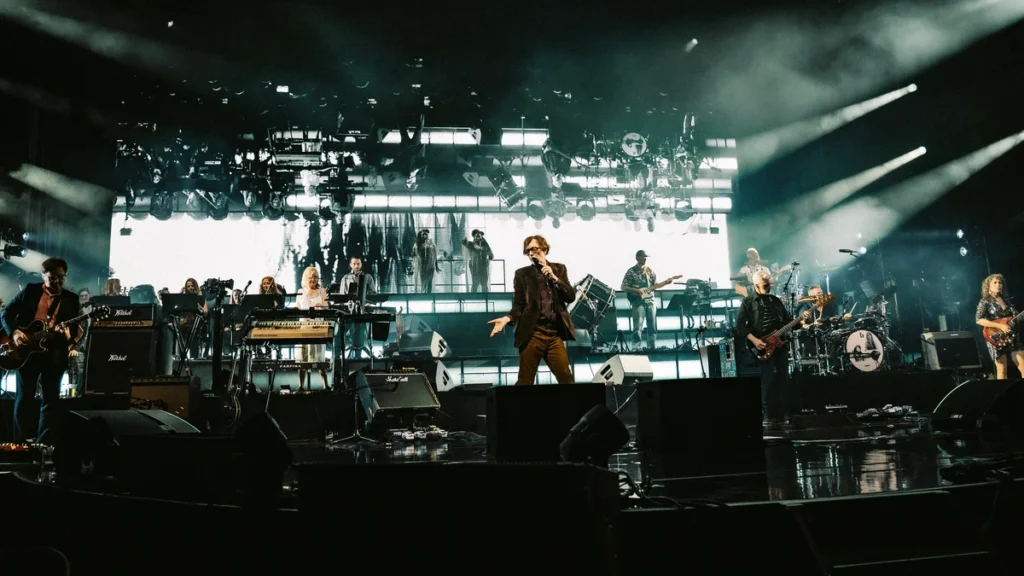
Pulp on stage at The O2 Arena in London, June 2025, the run that produced the live album.
Pulp on stage at The O2 Arena in London, June 2025, the run that produced the live album.
Five hundred and sixty-six, then five hundred and sixty-seven. Those are the performance numbers Rough Trade attaches to the two O2 Arena nights that make up Pulp Live!, and they are a more useful measure of the band’s position than any review score.
The album is out on 28 August. The recordings were made in June 2025, in the week the band’s first album in 24 years reached Number 1.
Two Nights, Counted Precisely
Bands rarely publish a running total of their own shows. Rough Trade’s announcement does exactly that, describing the O2 dates as the 566th and 567th performances of the band’s career and a snapshot of a group at the height of its powers.
The figure is worth sitting with. A career total in the mid-500s is modest by touring-band standards, and it reflects a group that stopped for long stretches rather than one that toured continuously. That is the context the live album is documenting: not a road-hardened machine, but a band that returned.
It also explains why two specific nights could be singled out at all. A band playing 100 shows a year produces a blur of interchangeable performances. A band that has played 567 in total, with multi-year gaps between runs, can point at an individual date and say what was happening that week.
The choice of the O2 rather than a festival slot is consistent with that. An arena show is the band’s own audience, their own running order and their own staging, with no fixed set length imposed by a bill.
Recorded in the Week of a Number 1
The timing is the other number that matters. The shows were recorded the week More, Pulp’s first album in 24 years, hit Number 1 on the Official UK Chart. Official Charts counts six Top 10 albums for the band, with More the third to reach the summit.
A 24-year gap followed by a chart-topper is an unusual sequence. It means the audience did not simply persist, it grew or renewed, and the O2 recordings capture the point at which that became measurable rather than anecdotal.
Old and new material appear together for the first time on record here, which is the practical argument for a live album from a reunion campaign: it is the only format where a 1995 single and a 2025 one sit in the same running order as a single performance.
The catalogue arithmetic supports the decision. Six Top 10 albums across a career, three of them Number 1, and a 24-year interval between the last two studio records. A studio album has to justify itself against the back catalogue. A live album simply presents the back catalogue, with the new songs positioned inside it rather than measured against it.
That is also why the running order matters more than the fidelity. A live record from a band in this position is a sequencing argument about which era belongs beside which.
What Jarvis Cocker Says the Title Means
The band framed the record around the word itself. “A concert is an event where songs come back to life. That’s why this album is called Live!” Jarvis Cocker said in the announcement. “It’s both a statement of fact (it’s a recording of a live band) & a challenge (come on! Everyone come alive!).”
That is the only quote the campaign leans on, and it does the work. The album is not being sold as a document of a farewell or an anniversary. It is being sold as evidence of a working band.
An Album and a Film From the Same Two Nights
The O2 footage serves twice. Garth Jennings filmed both performances, and that footage is the main content of Pulp: What Do You Do For an Encore?, which premieres worldwide later this autumn. Live! is the band’s first film soundtrack album.
Jennings’ involvement is not new. His relationship with the band dates to 1997, when he directed the video for Help the Aged. When Pulp announced they were touring again in 2023 he offered to help design the staging concept, then filmed the arena run two years later.
That continuity explains why the visual and audio releases share a source. The staging was designed by the person who then filmed it, so the concert film is not a camera crew dropped into someone else’s show.
The Formats and the Singles
Live! is released on double vinyl, with a limited blue pressing sold through the band and label webstore and independent record shops alongside a standard black edition, plus double CD and digital streaming.
Two live singles went out ahead of it, Disco 2000 and A Sunset. That pairing is deliberate: one is the band’s most recognisable single, the other comes from the album that returned them to Number 1. Together they advertise exactly what the record does, which is put both eras on one stage.
Physical formats matter to the chart arithmetic. A double vinyl and a double CD, sold to an audience that has just bought a Number 1 album, is the configuration most likely to produce a strong opening week for a live release.
The limited blue pressing is aimed squarely at independent record shops and the band’s own store, which is the standard route for a release that expects its demand to be concentrated rather than broad. It converts a loyal audience into first-week units without relying on supermarket or streaming volume.
Live albums rarely have long chart tails. They open where the fanbase puts them and then fall, because there is no radio single to sustain them and no discovery mechanism pulling in listeners who do not already know the songs. Whatever position Live! reaches in its first week is likely to be its peak.
A Release Week With Five Established Chart Records in It
Live! does not arrive quietly. The same Friday brings Alex Warren’s second album, following a Number 1 debut and a single that spent 13 weeks at the top of the singles chart. The Prince estate releases Timeless, drawn from a catalogue with five UK Number 1 albums, 22 Top 10s and 34 Top 40 entries. Post Malone’s 2016 debut mixtape reaches streaming for the first time, remastered.
Perrie reissues a Top 5 debut as a Fan Edition. Bananarama mark 40 years of True Confessions with a remastered expanded set. NCT 127 release a tenth-anniversary album, and Manchester’s The Guest List make their first Albums Chart bid with Something Real, recorded in Bergen.
Alabama Shakes return after more than a decade with a third album, Interpol deliver an eighth, and Dinosaur Jr., Sara Bareilles, Train and Rod Wave all release the same week. For a live album, that is a difficult field, because a live record competes for the same buyers as every studio release around it while offering material those buyers largely already own.
Released the Night They Play Manchester
The release date is not a neutral choice. Pulp are onstage on 28 August, playing a sold-out show at Manchester’s Wythenshawe Park with Self Esteem. The live album arrives the same day the band are performing live.
For a group whose catalogue keeps returning to the chart, that kind of scheduling is how heritage acts convert attention into units, a pattern we looked at when vinyl’s actual share of the market turned out to be far smaller than the discussion around it suggests.
The numbers to watch are straightforward. Six Top 10 albums, three of them Number 1, a 24-year gap closed, and two shows out of 567 chosen to represent the whole of it.
About The Author